


Why Payroll Tax Negotiation Can Save Your Business
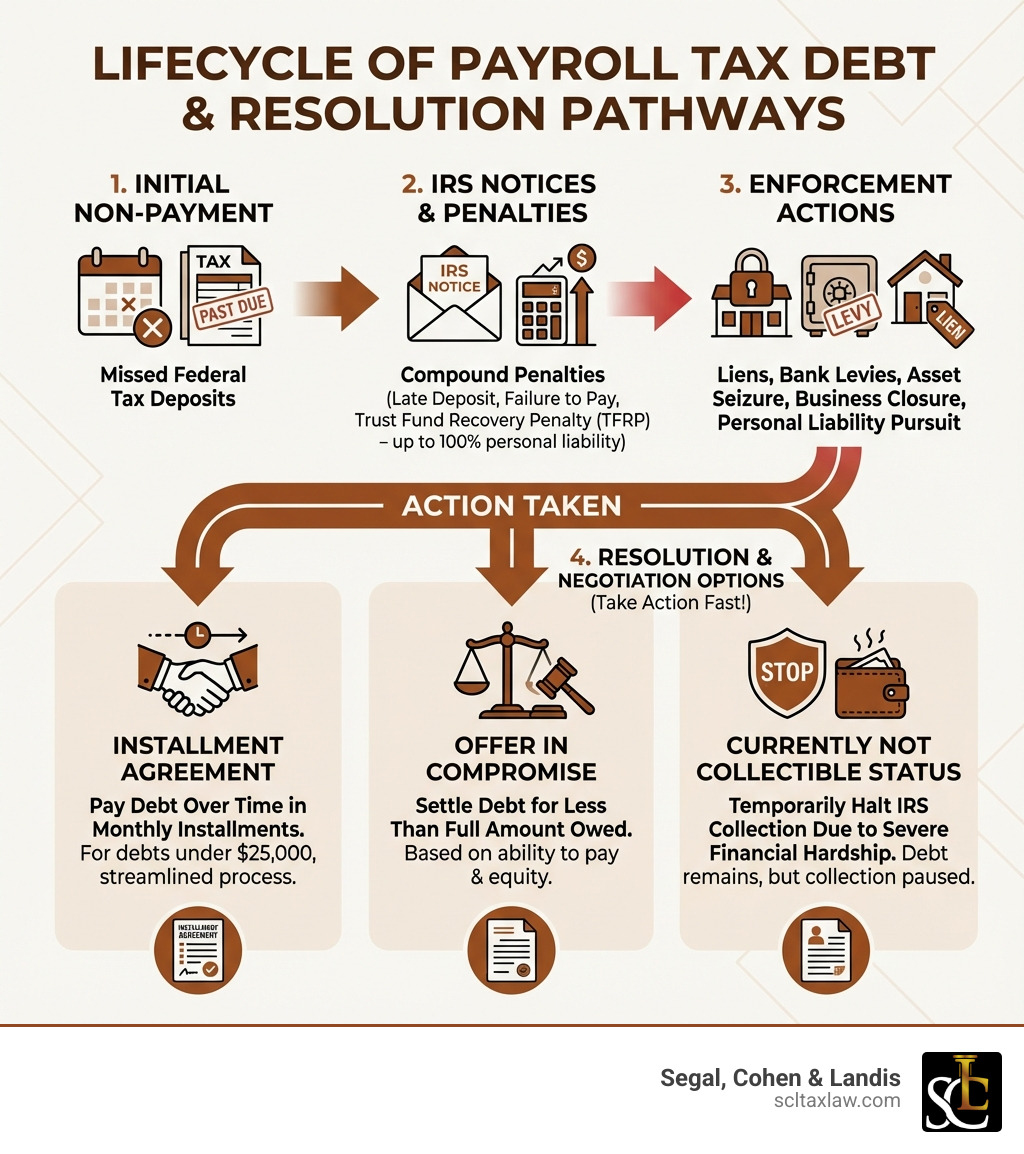
Payroll tax negotiation is the process of working with the IRS to resolve unpaid payroll taxes through payment plans, settlements, or other relief programs. If you owe back payroll taxes, you typically have three main options:
- Installment Agreement – Pay your debt over time in monthly installments
- Offer in Compromise – Settle your debt for less than the full amount owed
- Currently Not Collectible Status – Temporarily halt IRS collection if you’re facing severe financial hardship
The IRS never forgets unpaid payroll taxes and relentlessly pursues what’s owed. Unlike other tax debts, payroll taxes involve money you withheld from your employees’ paychecks—the IRS considers this a trust fund that you held on behalf of the government. When you fail to remit these funds, the IRS can take aggressive action including levying your bank accounts, seizing business assets, and even holding you personally liable for 100% of the unpaid trust fund taxes through the Trust Fund Recovery Penalty.
Payroll tax debt is one of the harshest tax problems a business can face. The penalties are severe—ranging from 2% to 15% for late deposits, plus a potential 100% personal liability penalty. The IRS has broad enforcement powers, including the authority to padlock your business, confiscate revenue, and pursue your personal accounts. Many business owners find themselves in this situation due to cash flow problems, using withheld funds to pay other creditors, or simple administrative errors.
But there’s good news: resolution options exist. The IRS offers several programs specifically designed to help businesses resolve payroll tax debt, including installment agreements for debts under $25,000, offers in compromise for qualifying cases, and penalty abatement for reasonable cause. The key is taking action quickly before penalties multiply and the IRS escalates to enforced collection.
Review the relevant notices, filing history, records, and deadlines before choosing a response. Evaluate professional assistance according to the facts, applicable law, and agreed scope of representation.
Understanding Payroll Tax Problems: Why the IRS Is So Aggressive

The IRS views small businesses as a significant source of uncollected revenue, largely due to unpaid payroll taxes. This isn’t just about missing a payment; it’s about misusing funds designated for the government. The IRS certainly takes unpaid taxes seriously, and we’ve seen how an IRS disruption of this magnitude can be difficult for many small businesses to survive. That’s why understanding these taxes and their implications is crucial. For a deeper dive into these consequences, see our guide on Consequences of Unpaid Payroll Taxes and Solutions with a Payroll Tax Attorney.
What Are Payroll Taxes and Why Are They Important?
Payroll taxes, also known as employment taxes, are a combination of taxes withheld from an employee’s wages and taxes paid directly by the employer. They are fundamental to our federal system, funding crucial programs like Social Security and Medicare. These taxes are not optional and are mandated under federal law.
The primary components of federal payroll taxes include:
- Federal Income Tax Withholding: Employers are required to withhold federal income tax from employee wages based on the information provided on their W-4 form.
- Federal Insurance Contributions Act (FICA) Taxes: These include Social Security and Medicare taxes. Employers must withhold the employee’s portion (6.2% for Social Security up to a wage base limit, and 1.45% for Medicare on all wages) and pay an employer portion that matches these amounts. An additional 0.9% Medicare tax applies to employee income above certain thresholds (e.g., $200,000 for single filers). You can find more details on FICA taxes from the SSA.
- Federal Unemployment Tax Act (FUTA) Taxes: These taxes fund unemployment compensation. Employers generally pay 6% on the first $7,000 of each employee’s wages. However, employers can often receive a credit of up to 5.4% for timely paid state unemployment taxes, effectively reducing the federal rate to 0.6%. FUTA tax is not withheld from employee wages. Learn more about FUTA from the IRS.
Employers report these taxes to the IRS using specific forms: IRS Form 941, Employer’s Quarterly Federal Tax Return is filed quarterly to report withheld income tax and FICA taxes. IRS Form 940, Employer’s Annual Federal Unemployment (FUTA) Tax Return is filed annually for FUTA taxes. These forms are critical for compliance.
The funds withheld from employee wages (federal income tax, and the employee’s share of Social Security and Medicare) are considered “trust fund taxes.” This means the employer is holding these funds in trust on behalf of the government until they are deposited with the IRS. Misusing these funds is viewed very seriously by the IRS.
Common Reasons Businesses Fall Behind on Payroll Taxes
While no business sets out to intentionally skip payroll tax payments, we’ve seen numerous reasons why businesses fall behind:
- Cash Flow Shortages: This is perhaps the most common culprit. A business might experience a temporary dip in revenue and, in a desperate attempt to keep the lights on or pay other critical expenses (like rent or suppliers), they may use the withheld payroll tax funds. The intent might be to replace the funds before the deadline, but often, that doesn’t happen. As one of our sources notes, what starts as a temporary cash fix can turn into a major compliance violation.
- Bookkeeping Errors and Inexperience: Incorrect calculations, missed deadlines, or improper reporting due to inexperienced staff, lack of robust systems, or poor communication can lead to significant problems. Employers might forget to file Form 941 or Form 940, or submit them with incorrect figures.
- Misclassifying Workers: Some employers mistakenly (or intentionally) try to avoid payroll tax obligations by classifying workers as independent contractors instead of employees. This avoids withholding Social Security, Medicare, or federal income taxes. However, if the IRS determines the workers were indeed employees, the business will be liable for all back payroll taxes, penalties, and interest. This is a common issue we address in our Business Tax Problems: Ultimate Guide.
- Business Transitions or Closures: During periods of significant change, such as mergers, acquisitions, or even business closures, payroll tax obligations can be overlooked or mishandled, leading to outstanding liabilities.
The Severe Penalties for Unpaid Payroll Taxes
The IRS takes a very dim view of unpaid payroll taxes because they involve funds held in trust for the government. The consequences are swift and severe:
- Failure to Deposit Penalty: This is the most common penalty. If you fail to deposit your owed employment taxes on time, the IRS assesses a penalty based on how late the payment is:
- 2% for 1 to 5 days late
- 5% for 6 to 15 days late
- 10% for 16 or more days late
- 15% if 10 or more days after the first IRS notice.
- Trust Fund Recovery Penalty (TFRP): This is where things get personal. The TFRP allows the IRS to hold individuals personally liable for 100% of the unpaid trust fund taxes (the federal income tax, Social Security, and Medicare taxes withheld from employee wages). This penalty applies to any “responsible person” who “willfully” fails to collect, account for, or pay over these taxes.
- A “responsible person” is anyone with the authority and control over the business’s finances who can make decisions about paying creditors. This can include business owners, officers, directors, partners, or even employees with significant financial authority.
- “Willful failure” doesn’t require malicious intent. It means the responsible person knew the taxes were due and had the ability to pay them but chose to use the funds for other purposes or showed reckless disregard for the tax obligations. As stated in Section 6672(a) of the Internal Revenue Code, the IRS can pursue your personal assets. You can learn more about this severe penalty on our Trust Fund Recovery Penalty page.
- Tax Liens and Levies: The IRS can file a Federal Tax Lien against your business’s assets (and potentially your personal assets if TFRP is assessed), making it difficult to sell property or obtain credit. They can also issue a Federal Tax Levy, seizing bank accounts, accounts receivable, or business property.
- Criminal Prosecution: In extreme cases, where the IRS believes non-payment was willful or tied to fraud or tax evasion, they may pursue criminal charges. U.S. Code Title 26 §7202 outlines that if a business owner or responsible party willfully fails to pay employment taxes, felony charges may be brought, including imprisonment for up to five years. This is a rare, but very real, risk.
Your First Steps When You Owe Back Payroll Taxes

Facing unpaid payroll taxes can feel overwhelming, but taking immediate and strategic action can prevent the situation from spiraling further out of control. Proactive engagement with the IRS is crucial. For more detailed guidance, refer to our article on What to Do When You Owe Back Taxes: Expert Insights from an IRS Tax Law Firm.
Step 1: Determine the Full Scope of Your Debt
Before you can negotiate, you need to know exactly what you’re dealing with. This means accurately assessing all outstanding tax liabilities, including penalties and interest.
- Review IRS Notices: The IRS typically sends notices if you have unpaid balances. For instance, a CP161 notice informs you of a balance due for unpaid payroll taxes. Gather all notices you’ve received.
- Calculate Total Debt: You need to know precisely how much you owe in back taxes, as well as the associated penalties and interest.
- Access Your IRS Account/Transcripts: You can access your online IRS account to review your tax transcripts and exact balance. Alternatively, we can help with IRS Transcript Retrieval to get a comprehensive view of your tax situation.
- Reconcile Your Records: Compare your internal records with IRS information. Review any Form 941 and Form 940 you may have filed for the periods in question. If returns weren’t filed, the IRS may have filed a substitute return estimating what you owe.
Step 2: Get Current on All Tax Filings
Even if you can’t pay, filing your returns is a critical step. The penalty for failing to file (5% of the tax per month) is significantly higher than the penalty for failing to pay (0.5% per month).
- File Delinquent Returns: Our primary goal is to ensure you are compliant. This means filing any missing Unfiled Tax Returns, starting with delinquent Form 941s.
- Correct Errors: If you find that previously reported payroll tax amounts were incorrect due to miscalculations or bookkeeping errors, you must file Form 941-X, Adjusted Employer’s Quarterly Federal Tax Return or Claim for Refund, to correct those errors.
- Prerequisite for Negotiation: The IRS generally will not discuss payment options or debt resolution until all required tax returns are filed and current.
Step 3: Resume Timely Tax Deposits
Once you’ve assessed your debt and filed all delinquent returns, the next crucial step is to prevent the debt from growing larger.
- Make Current Payments: Begin making all current payroll tax deposits on time. This demonstrates good faith to the IRS and stops the accumulation of new penalties and interest.
- Use EFTPS: The most efficient way to make federal tax payments is through the Electronic Federal Tax Payment System (EFTPS). This secure, IRS-managed platform allows you to pay federal taxes directly from your bank account.
- Review the relevant notices, filing history, records, and deadlines before choosing a response. Evaluate professional assistance according to the facts, applicable law, and agreed scope of representation. Related resources: Handling Payroll Taxes: What to Know and How a Payroll Tax Attorney Can Help.
Mastering IRS Payroll Tax Negotiation: Your Key Resolution Options
Once you’ve taken the initial steps to get compliant and stop the bleeding, we can explore various IRS resolution programs. Our goal in any payroll tax negotiation is to find the best possible outcome for your business. You can find a comprehensive overview in our IRS Tax Debt Resolution: Complete Guide.
Option 1: IRS Installment Agreement
An Installment Agreement allows you to pay your tax debt over a set period, with terms depending on eligibility, the balance, and the remaining collection period, in monthly installments. This is a common and straightforward option if you can afford to pay your full liability over time.
- Eligibility: For a Simple Payment Plan, businesses with trust fund taxes generally must owe $25,000 or less in assessed taxes, penalties, and interest, or $50,000 or less for an out-of-business sole proprietorship. Applicants must be current with filing and payment requirements. Other payment plans may be available above these limits. If your debt exceeds this amount, you might need to pay it down to qualify for an online agreement, or we can negotiate a more complex payment plan directly with the IRS.
- Review the relevant notices, filing history, records, and deadlines before choosing a response. Evaluate professional assistance according to the facts, applicable law, and agreed scope of representation.
- Application Process: You can request an Installment Agreement online (if eligible), by mail, or by speaking directly with an IRS representative. For larger or more complex cases, or if you need a Partial Pay Installment Agreement, professional assistance is invaluable. Learn more about IRS Partial Pay Installment Arrangements: An Overlooked IRS Resolution Alternative.
Option 2: The Offer in Compromise (OIC) for Payroll Tax Negotiation
An Offer in Compromise (OIC) allows certain taxpayers to settle their tax debt for a lower amount than what they originally owe. The IRS considers an OIC when there’s “doubt as to collectibility,” meaning they believe you cannot pay the full amount due to your financial circumstances.
- Eligibility: The IRS evaluates your ability to pay, income, expenses, and asset equity. They want to ensure the offered amount represents the most they can expect to collect within a reasonable timeframe. You can use the Offer in Compromise Pre-Qualifier Tool online to see if you might qualify.
- Application Requirements: The application process is rigorous and requires careful preparation. You’ll need to submit Form 656, Offer in Compromise, along with Form 433-B, Collection Information Statement for Businesses, and supporting financial documentation. A non-refundable application fee ($205) and an initial payment are typically required unless an individual or sole proprietor qualifies for Low-Income Certification. Other business entities do not qualify for this exception.
- Special Considerations for Payroll Taxes: A business offer generally requires the trust fund portion to be paid or TFRP determinations to be made for all potentially responsible parties. Acceptance of the business offer does not necessarily release their separate liability. Special procedures may apply to a victim of payroll-service-provider fraud or failure; the facts and current Form 656-B instructions must be reviewed. The OIC process is complex, and we’ve put together an Offer in Compromise Complete Guide to help you steer it.
Option 3: Currently Not Collectible (CNC) Status
Business CNC eligibility depends on the entity and its finances. Operating corporations generally must remain current with filing and payment requirements and lack collectible assets or income; hardship alone does not establish eligibility.
- Temporary Relief: While in CNC status, the IRS generally delays most collection, including levies, but may still file a Notice of Federal Tax Lien and apply refunds to the debt. However, the debt remains, and penalties and interest continue to accrue.
- Monitoring: The IRS will periodically review your financial situation. If your financial condition improves, they can resume collection efforts.
- Statute of Limitations: While in CNC status, the 10-year Collection Statute Expiration Date (CSED) for the IRS to collect the debt continues to run, though certain actions can pause it. This status offers a crucial breathing room, and you can learn more on our IRS Currently Not Collectible Status page.
Special Programs and Penalty Relief
Beyond payment plans, other options exist for specific situations:
- Voluntary Classification Settlement Program (VCSP): If you’ve misclassified workers as independent contractors, the VCSP offers an opportunity to reclassify them as employees for future tax periods with partial relief from federal employment taxes. This can prevent significant future liabilities.
- Penalty Abatement: In some cases, we can request an abatement of penalties due to reasonable cause. This means demonstrating that you exercised ordinary business care and prudence but were unable to comply due to circumstances beyond your control (e.g., natural disaster, serious illness, or reliance on incorrect advice). This can significantly reduce your overall debt. Our IRS Penalty Abatement: Complete Guide provides more information.
The Critical Role of a Tax Attorney in Your Negotiation
When dealing with the IRS, especially concerning payroll tax issues, the stakes are incredibly high. The complexity of tax law and the aggressive nature of IRS collection make professional representation not just helpful, but often essential. We believe in providing expert advice for small business owners, as detailed in Payroll Tax Problems: Understanding Your Liability and the Need for Tax Attorneys.
Why You Shouldn’t Face the IRS Alone
Going up against the IRS without experienced legal counsel can be a costly mistake:
- Complex Tax Code: The tax code is vast and intricate. Understanding the nuances of payroll tax law, including the Trust Fund Recovery Penalty (TFRP) and various resolution options, requires specialized knowledge.
- High Stakes: Unpaid payroll taxes can lead to severe financial penalties, business disruption, and even personal financial ruin. The IRS has the power to padlock your business, seize assets, and pursue you personally.
- Personal Liability Risk: The TFRP is a unique and aggressive penalty. The IRS will conduct thorough investigations to identify “responsible persons” and their “willfulness.” This often involves interviews (like the 4180 Interview) where any misstep can lead to a 100% personal liability assessment. The TFRP is not dischargeable in bankruptcy, making it a debt that can follow you forever. Our page on the Trust Fund Recovery Penalty details this risk.
- Negotiation Experience: The IRS is a formidable adversary. Experienced tax attorneys know their procedures, their limits, and how to present your case most effectively to achieve the best possible outcome. We speak their language.
- Protecting Your Rights: We ensure your rights are protected throughout the process, from initial contact to appeals. We can challenge IRS assessments, defend against collection actions, and ensure due process is followed.
How a Tax Attorney Can Help with Your Payroll Tax Negotiation
Review the relevant notices, filing history, records, and deadlines before choosing a response. Evaluate professional assistance according to the facts, applicable law, and agreed scope of representation.
- Assessing Your Case: We conduct a thorough review of your tax history, financial situation, and the specifics of your payroll tax debt to identify the most viable resolution strategies.
- Preparing Applications: We carefully prepare all necessary forms and supporting documentation for Installment Agreements, Offers in Compromise, or requests for CNC status, ensuring accuracy and completeness to maximize your chances of approval.
- Defending Against TFRP Assessment: If you’re facing a TFRP assessment, we can represent you during the investigation, prepare you for interviews, and build a strong defense against personal liability.
- Negotiating Payment Terms: We negotiate directly with the IRS on your behalf, advocating for the most favorable payment terms and exploring all available relief options.
- Review the relevant notices, filing history, records, and deadlines before choosing a response. Evaluate professional assistance according to the facts, applicable law, and agreed scope of representation. Related resources: IRS Audit.
- Appealing IRS Decisions: If an initial request is denied or you disagree with an IRS decision, we can guide you through the appeals process, presenting a compelling case for reconsideration.
Frequently Asked Questions about Payroll Tax Negotiation
Can payroll tax debt be discharged in bankruptcy?
This is a critical distinction: No, the trust fund portion of payroll tax debt cannot be discharged in bankruptcy. The IRS considers these funds to be held in trust, meaning they were never truly yours to begin with. This makes them a priority debt. Even if your business declares Chapter 7 or Chapter 13 bankruptcy, the individuals deemed “responsible persons” under the Trust Fund Recovery Penalty (TFRP) can still be held personally liable for 100% of the unpaid trust fund taxes. The employer’s portion of payroll taxes might be dischargeable under very specific, strict conditions, but the trust fund portion (employee withholdings) almost never is. Seeking legal advice is crucial to understand your specific situation.
How long does the IRS have to collect payroll tax debt?
The IRS generally has 10 years from the date the payroll tax was assessed to collect the debt. This is known as the Collection Statute Expiration Date (CSED). However, it’s important to understand that certain actions can pause or extend this 10-year period. For example, if you:
- File an Offer in Compromise
- Have an installment-agreement request pending; an approved agreement alone does not automatically suspend the collection period
- Request a Collection Due Process (CDP) hearing
- Go into bankruptcy
These actions can effectively “stop the clock” on the CSED, giving the IRS more time to collect. This is why strategic payroll tax negotiation is so important – it can prevent the IRS from taking aggressive collection actions while you work towards a resolution, but it also impacts the collection period.
What is the difference between payroll taxes and self-employment taxes?
While both payroll taxes and self-employment taxes contribute to Social Security and Medicare, they apply to different types of workers and have distinct payment mechanisms:
- Payroll Taxes: These apply to employees. The employer withholds the employee’s share of FICA taxes (Social Security and Medicare) and federal income tax from their wages. The employer then matches the employee’s FICA contributions and remits all these amounts to the IRS.
- Self-Employment Taxes: These apply to independent contractors or self-employed individuals. Since there’s no employer to withhold taxes, the self-employed individual is responsible for paying both the employer and employee portions of Social Security and Medicare taxes themselves. This is calculated as the Self-Employment Contributions Act (SECA) tax. The current rate is 15.3% on net earnings from self-employment (12.4% for Social Security up to a wage base limit, and 2.9% for Medicare on all earnings). Self-employed individuals also pay their income tax. These taxes are typically paid quarterly through estimated tax payments using Form 1040, Schedule SE Instructions (PDF).
The key difference lies in who is responsible for withholding and paying the taxes, and how they are reported.
Conclusion: Take Control of Your Payroll Tax Debt Today
The stress of unpaid payroll taxes can be overwhelming, threatening your business and even your personal assets. But as we’ve explored, proactive resolution is key, and numerous options are available for payroll tax negotiation. Don’t delay—the longer you wait, the more penalties and interest accrue, and the more aggressive the IRS becomes.
Review the relevant notices, filing history, records, and deadlines before choosing a response. Evaluate professional assistance according to the facts, applicable law, and agreed scope of representation.
Contact us for expert payroll tax help today.
Have questions about this topic? Talk to an IRS attorney today.
Segal, Cohen & Landis, P.C. — Beverly Hills. Serving clients nationwide.

Samuel Landis, Esq.
LL.M. (Tax) · Selected to Super Lawyers®
Sam Landis is a Beverly Hills IRS tax attorney specializing in IRS collection defense, audit representation, and international tax compliance for foreign nationals and US expats.