

What an IRS Audit Means and What to Do First
An IRS audit is an examination of a tax return and its supporting records to check whether the income, deductions, credits, and other tax items reported are accurate. In simple terms, the audit IRS definition is the IRS reviewing your return to determine whether you paid the correct amount of tax.
An audit notice does not automatically mean you did something wrong. It does mean you should act carefully:
- Read the notice and response deadline.
- Confirm it is a real IRS letter.
- Gather only the records requested, such as receipts, bank statements, or payroll records.
- Do not ignore the notice or alter documents.
- Consider speaking with a tax attorney before giving detailed records or answering audit questions.
IRS audits may be handled by mail, at an IRS office, or through a field examination. The process can end with no changes, an agreed adjustment, or a dispute that may continue through IRS Appeals or Tax Court.
audit IRS definition: Review the relevant notices, filing history, records, and deadlines before choosing a response. Evaluate professional assistance according to the facts, applicable law, and agreed scope of representation.
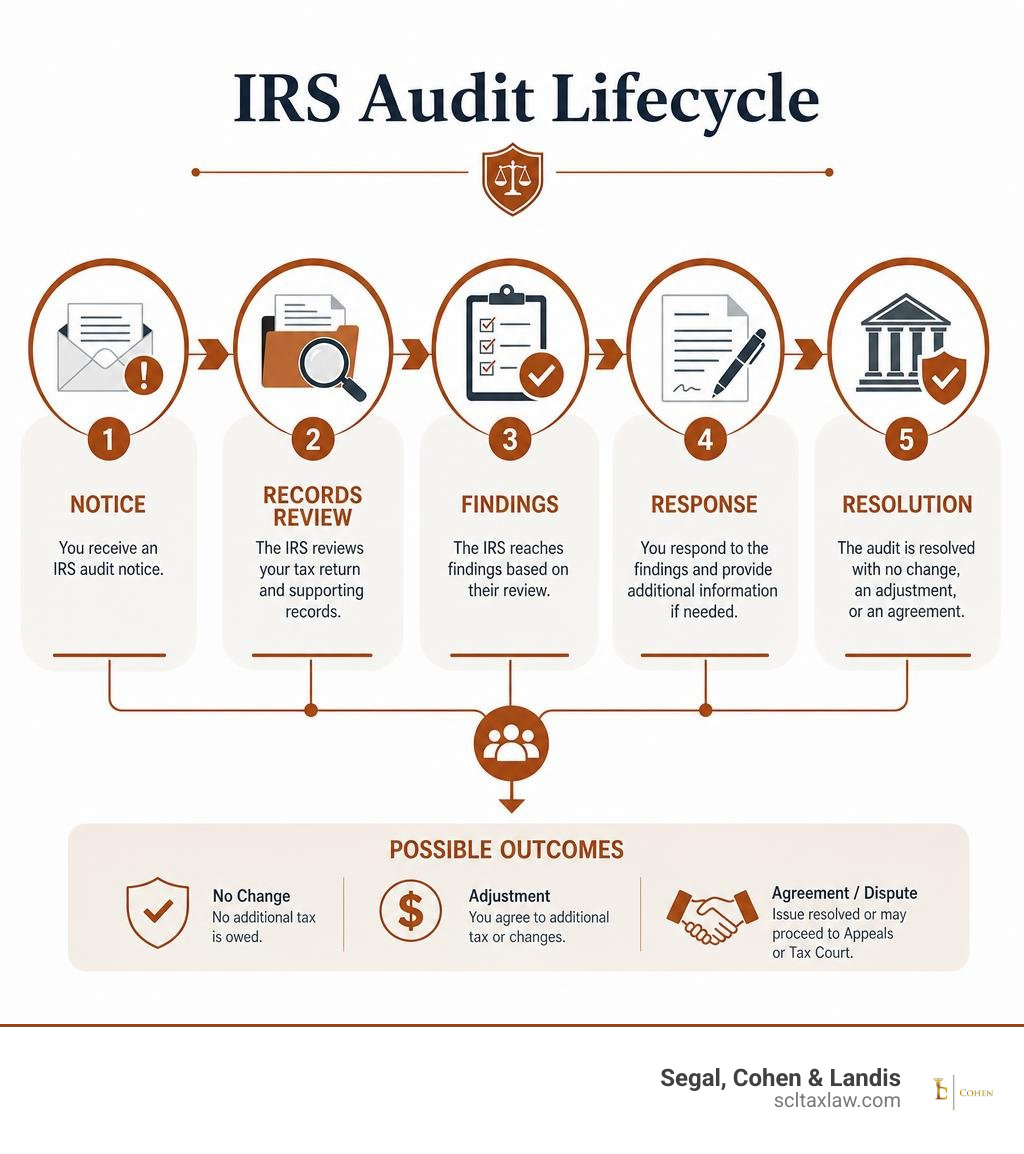
Audit irs definition definitions:
Audit IRS Definition and Core Examination Concepts
When people ask what is a audit, they often envision an adversarial interrogation. In reality, a tax examination is a formal administrative review. Under Internal Revenue Code (IRC) Section 7602, Congress grants the Internal Revenue Service broad legal authority to examine books, papers, records, or other relevant data to ascertain the correctness of any return, make a return where none has been filed, or determine the liability of any person for internal revenue tax.
At its core, the primary goal of the examination is verification of income and substantiation of claimed credits and deductions. The Examination (Audit) Process ensures that the tax system operates equitably under the law. When examiners review financial records, they match third-party data against the information reported on the tax return to establish the actual tax liability. For an overview of how these definitions play out during an examination, taxpayers often turn to the taxman cometh a clear guide to irs audit meanings.
Official Audit IRS Definition According to the Internal Revenue Manual
The Internal Revenue Manual (IRM) serves as the primary operational blueprint for all IRS personnel. Under Title 26 authority and IRM Part 4, an audit is formally defined as an official examination of an individual or entity’s tax return to substantiate that all financial activities were reported in compliance with statutory federal tax laws.
The scope of an audit is governed strictly by federal statutes, including IRC Section 7605, which sets rules on the time and place of examinations and protects taxpayers from unnecessary or repetitive reviews. Once an auditor concludes their evaluation, they compile their findings into an examination report, typically presented on Form 4549 (Income Tax Examination Changes). According to official guidelines detailed in IRS audits | Internal Revenue Service, the IRM outlines exact procedural steps examiners must follow, a framework we explore in depth in a comprehensive guide to irs audit basics.
How the Audit IRS Definition Applies to Small Businesses and Individuals
The practical execution of an audit varies depending on the type of taxpayer being examined:
- Individual Returns: An individual tax audit typically centers around itemized deductions (Schedule A), child tax credits, filing status validations, capital gains, or sole proprietorship activities (Schedule C).
- Business Returns: A business tax audit focuses heavily on gross receipts reconciliation, cost of goods sold (COGS), executive compensation, travel and entertainment expenses, and balance sheet integrity for partnerships (Form 1065) and corporations (Form 1120/1120-S).
In every case, whether handling an individual or corporate federal income tax audit, the examiner’s mandate is to establish true taxable income by cross-referencing gross receipts with allowable deductions under the tax code.
Why Returns Are Selected for IRS Audits
Many taxpayers assume they were audited because an agent personally singled out their return. In reality, the vast majority of examinations originate through automated computer screening algorithms.
IRS scoring may assess the potential for a change or underreported income. UIDIF concerns underreported income; its formula should not be inferred or portrayed as a scoring system only for business entities.
Other primary selection methods include:
- Information Matching: The Automated Underreporter (AUR) system scans for discrepancies between filed returns and third-party data documents, such as Form W-2, Form 1099, Form 1098, and Schedule K-1. Discrepancies often trigger an inquiry into irs audit unreported income.
- Third-Party Information and Special Rules: Inconsistencies involving dependents, such as multiple parents claiming the same child, frequently spark an audit for claiming dependents.
- Related Examinations: If a business partner, investor, or corporate entity is audited, the IRS may open linked audits for related individual returns.
Understanding these selection criteria is key when learning how to audit proof your tax preparation and avoid tax audit risks.
Common Triggers for Small Business Examinations
Small businesses face distinct audit exposure due to the complexity of commercial bookkeeping. Key triggers include:
- Excessive Deductions Relative to Income: Claiming large losses year after year on Schedule C or writing off disproportionate vehicle, travel, and meal expenses.
- Worker Classification Disputes: Reclassifying workers as independent contractors (1099-NEC) rather than employees (W-2), which can lead to an intensive irs payroll audit.
- COVID-Era Relief Claims: Strict post-pandemic scrutiny continues in August 2026, particularly regarding Employee Retention Credit filings via erc credit audits.
- High Cash Volume: Businesses that handle substantial physical currency (such as restaurants, retail shops, or service contractors) face increased scrutiny regarding reported receipts and Form 8300 compliance.
- Evolving IRS Priorities: Shifting enforcement mandates for 2025 tax audits and subsequent tax years have placed additional emphasis on high-income pass-through entities and digital asset reporting.
Types of IRS Audits and Examination Methods
The IRS conducts examinations through three primary formats:
| Audit Format | Location Conducted | Scope & Complexity | Typical Handling Method |
|---|---|---|---|
| Correspondence Audit | By Mail | Targeted, 1–3 specific line items | Submission of requested documentation by mail or secure portal |
| Office Audit | Local IRS Office | Moderate; multiple line items or small business issues | In-person interview with a Tax Compliance Officer |
| Field Audit | Taxpayer’s Home, Office, or Representative’s Location | Comprehensive; complex business or high-net-worth returns | Detailed on-site examination by a specialized Revenue Agent |
Navigating these formats requires understanding the full scope of types of irs audits and properly reading the initial irs tax audit letter.
Correspondence Audits by Mail
A CP 2000 notice proposes an information-matching adjustment through the Automated Underreporter process; it is not a formal IRS examination. Follow the actual notice’s instructions and response deadline.
Taxpayers typically receive a strict 30-day response window. Our advice is simple: dont ghost the irs and other audit letter tips highlight that ignoring these notices leads directly to an automated default assessment with penalties and interest. If you need extra time to organize receipts, you can generally request a one-time 30-day extension. That receiving an audit after tax return accepted is normal, as acceptance merely confirms successful transmission, not substantive approval of your numbers.
Office and Field Audits
Office audits require the taxpayer or their legal representative to visit a local IRS facility to meet with a Tax Compliance Officer. These audits focus on issues that are too complex to resolve efficiently through the mail.
Field audits are the most comprehensive examination type. A Revenue Agent visits your place of business, personal residence, or your tax attorney’s office. Under the guidelines established in 4.70.13 Executing the Examination | Internal Revenue Service, agents review original general ledgers, examine point-of-sale systems, tour business premises, and interview management.
Holding a field audit at an on-site inspection can disrupt business operations and expose you to unnecessary questioning. Retaining legal counsel allows you to hold all meetings at your attorney’s office—a neutral meeting site—while preserving your right to an interview suspension if questions exceed the statutory scope.
The Examination Process, Required Documentation, and Lookback Limits
Managing an audit successfully relies on meticulous record retention and an understanding of statutory limits. When evaluating an audit tax return, examiners require primary substantiation, including bank statements, cancelled checks, credit card statements, contemporaneous mileage logs, vendor contracts, and general ledgers.
Taxpayers frequently wonder about lookback thresholds when reviewing are you at risk of an irs audit and how far back can the irs go.
How Far Back the IRS Can Audit Returns
The IRS does not have unlimited time to assess additional taxes. Under IRC Section 6501, specific statutory timeframes apply:
- Standard Three-Year Rule: Under general rules, the IRS must assess additional taxes within three years from the date the return was filed or the due date, whichever is later.
- Six-Year Rule for Substantial Omission: If a return omits gross income in excess of 25% of the gross income stated on the return, the assessment statute extends to six years.
- No Statute of Limitations: In cases of a false or fraudulent return filed with the intent to evade tax, or when no return is filed at all, the IRS can audit and assess taxes at any time without lookback limits.
Essential Documentation and Audit Preparation Strategies
Successful audit defense requires presenting records clearly and systematically. Auditors are less likely to expand the scope of their inquiry when records are neatly indexed.
Key preparation strategies include:
- Transcript Analysis: Requesting official IRS wage and income transcripts helps identify third-party data mismatches before meeting the agent. You can review this strategy in the essential guide to federal audit transcript retrieval and defense.
- Organized Lead Sheets: Group receipts by tax year and line-item category. Do not hand an auditor a disorganized box of loose receipts.
- Targeted Substantiation: Provide only the exact records requested in the Information Document Request (IDR). Volunteering extraneous documents often invites inquiries into otherwise unrelated tax years.
- Comprehensive Strategy: Employing an irs audit defense complete guide ensures your legal positions remain consistent from the initial interview through closing.
Taxpayer Rights, Potential Outcomes, and the Appeals Process
Taxpayers are protected by the statutory Taxpayer Bill of Rights under IRC Section 7803. These protections include the right to be informed, the right to quality service, the right to challenge the IRS’s position and be heard, the right to finality, and the right to retain professional representation. For a complete look at these protections, see what happens if the irs audits you.
Once the examiner finishes their review, they issue closing documents outlined in 4.10.8 Report Writing | Internal Revenue Service.
The Three Possible Audit Outcomes
Every IRS examination concludes with one of three primary determinations:
- No-Change Outcome: The taxpayer provided sufficient substantiation, and the return is accepted as originally filed with zero adjustments.
- Agreed Outcome: The auditor proposes adjustments resulting in an increased or decreased tax liability. If you agree, you sign Form 870 (Waiver of Restrictions on Assessment and Collection of Deficiency in Tax) or Form 4549, closing the audit and establishing a payment schedule.
- Disagreed Outcome: The auditor proposes adjustments, additional tax, or an irs accuracy related penalty essential guide assessment that you contest. The IRS then issues an examination report detailing the asserted irs tax deficiency.
Disagreeing with Findings: 30-Day Letters and Tax Court Petitions
If you do not agree with the auditor’s findings, you do not have to accept the proposed adjustments.
When an audit concludes unagreed, the IRS issues a 30-day letter along with the revenue agent’s report. You have 30 calendar days to file a formal written protest requesting a conference with the IRS Independent Office of Appeals. Appeals Officers are tasked with settling disputes impartially based on the “hazards of litigation.”
If an agreement cannot be reached at Appeals, the IRS issues a Statutory Notice of Deficiency (often called a 90-day letter). This notice starts a strict 90-day window to file a petition with the United States Tax Court. Filing this petition prevents the IRS from assessing or collecting the disputed tax while the case is litigated. For a detailed breakdown of these steps, read our guide on what to do when you disagree with an irs audit and explore from audit to appeal how an la irs tax lawyer can help.
Frequently Asked Questions About IRS Audits
Can the IRS initiate an audit over the phone or by email?
IRS audit contact generally begins by mail. Legitimate follow-up may use other authorized channels. Verify unexpected calls or messages using official IRS contact information before responding.
Can you pause an in-person IRS audit interview to consult an attorney?
Yes. Under IRC Section 7521(b)(2), if you are participating in an interview with an IRS employee and state that you wish to consult with an attorney, CPA, or enrolled agent, the examiner must immediately suspend the interview. You do not have to answer further questions until you secure legal counsel. Utilizing an irs audit representation complete guide ensures that you do not waive critical statutory rights, allowing you to obtain tailored irs tax audit help.
What is the difference between a federal IRS audit and a state tax audit?
A federal audit is conducted by the IRS to examine federal income, employment, or excise tax returns. State tax audits are handled by state revenue departments—such as the California Franchise Tax Board (FTB) for a california ftb audit or the Employment Development Department for a california edd audit complete guide. However, because the IRS shares information with state tax authorities under statutory data-sharing agreements, an adjustment on a federal audit often triggers a “piggyback” state examination. Further information regarding state-level procedures is available through the Audits – California Tax Service Center.
Conclusion
Understanding the procedural mechanics, statutory limits, and legal protections behind an IRS examination helps you approach an audit calmly and strategically. From the initial examination notice through document requests, Appeals conferences, and potential Tax Court litigation, every stage requires careful preparation and an awareness of your rights.
Review the relevant notices, filing history, records, and deadlines before choosing a response. Evaluate professional assistance according to the facts, applicable law, and agreed scope of representation. Related resources: irs audit representation.
Have questions about this topic? Talk to an IRS attorney today.
Segal, Cohen & Landis, P.C. — Beverly Hills. Serving clients nationwide.

Samuel Landis, Esq.
LL.M. (Tax) · Selected to Super Lawyers®
Sam Landis is a Beverly Hills IRS tax attorney specializing in IRS collection defense, audit representation, and international tax compliance for foreign nationals and US expats.