


When the IRS Says You Owe More: Understanding Tax Deficiency Notices
An IRS tax deficiency occurs when the IRS determines that you owe more tax than you reported on your return. This determination comes in the form of a formal letter—most commonly known as a Notice of Deficiency or 90-day letter—that explains the proposed additional tax, penalties, and interest.
Quick Answer: What You Need to Know About an IRS Tax Deficiency
- It’s not a bill yet – A Notice of Deficiency is a proposed tax increase, not a final assessment
- Check the last date to petition Tax Court on the notice. The petition period is generally 90 days; an outside-U.S. address rule can provide 150 days. Responding to the IRS does not extend the court deadline.
- Three main options: Agree and pay, disagree and provide information, or file a petition with U.S. Tax Court
- Missing the deadline is serious – If no timely petition is filed, the IRS generally may assess the deficiency after the applicable petition period. Collection procedures and remaining remedies require separate review.
- The most common trigger is when information from employers, banks, or other third parties doesn’t match what you reported
The IRS sends these notices when they believe there’s a discrepancy between what you reported and what their records show. This might happen because of unreported income, disallowed deductions or credits, or simply because you didn’t respond to earlier IRS correspondence. The notice will include a detailed explanation of how they calculated the deficiency, what adjustments they made, and most importantly, your rights to challenge their determination.
Why this matters: Read the last date to petition on the notice promptly. IRS correspondence does not extend that court deadline. If the proposed deficiency is assessed, ordinary collection notices and other procedural requirements may follow; a missed petition deadline does not by itself authorize every collection action immediately.
This guide explains the notice, the proposed adjustments and the separate administrative and Tax Court response routes. The notice and supporting records determine the options available in a particular case.
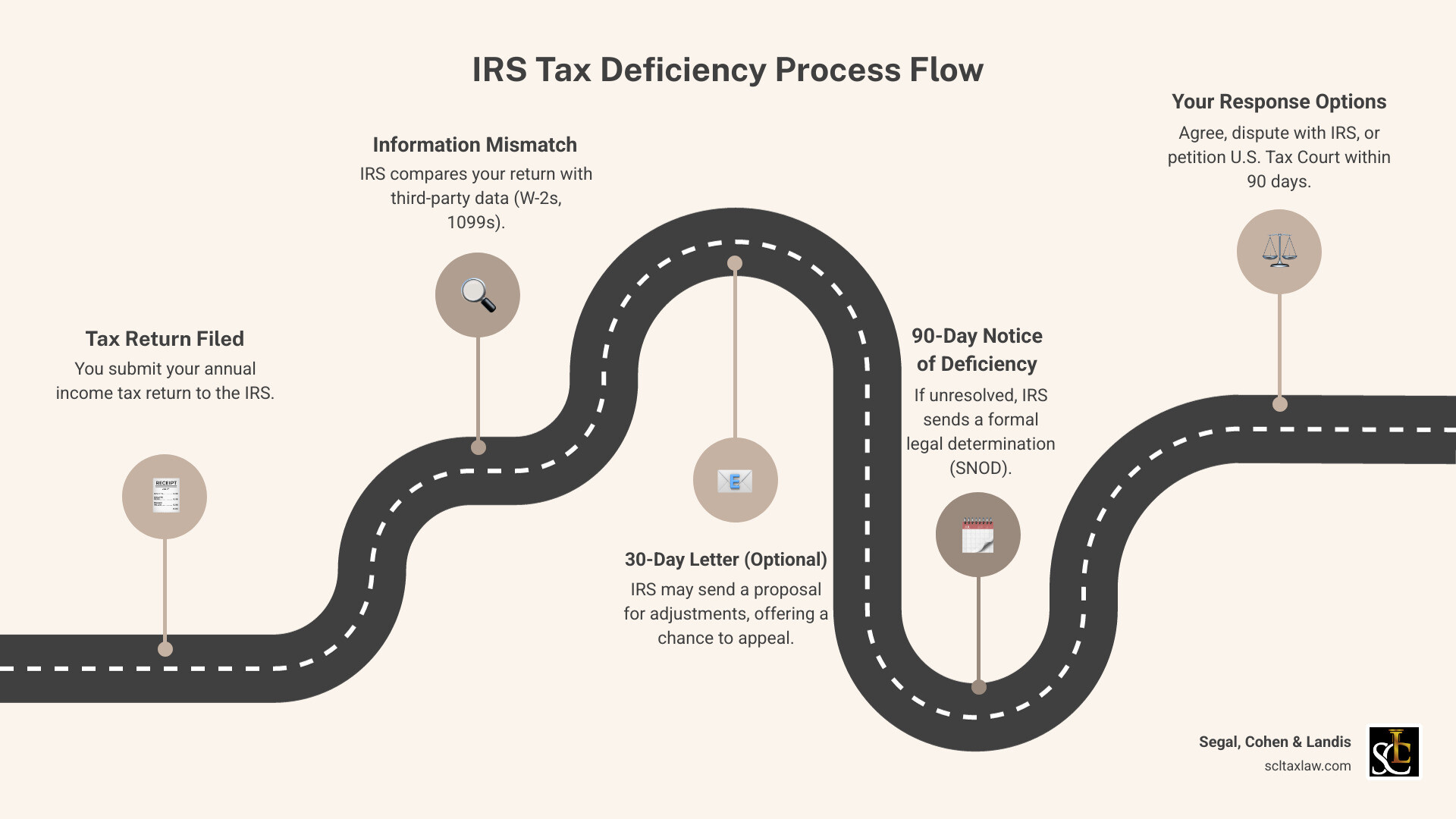
The following sections explain the notice, its deadline and response options. Available remedies depend on the notice, timing and facts; no favorable result is guaranteed.
Know your IRS tax deficiency terms:
What is a Notice of Deficiency? Unpacking the IRS Letter
When the IRS believes you owe more in taxes than you reported, they don’t just send a casual letter. They issue a Notice of Deficiency—a formal legal document that carries significant weight. You might also hear it called a “Statutory Notice of Deficiency” (SNOD) or, more commonly, a “90-day letter” because you typically have 90 days to respond.
The IRS uses specific form numbers for these notices, most commonly CP3219A or CP3219N. If you’ve received one of these, you’re holding one of the most important pieces of mail the IRS can send. The Understanding Your CP3219A Notice page on the IRS website provides their official explanation of what you’re looking at.

A Notice of Deficiency generally states a proposed tax increase rather than a bill for an already assessed deficiency. The notice provides a petition deadline. Assessment restrictions, statutory exceptions and any collection procedures should be evaluated for the particular case.
Think of it as the IRS saying, “We think you owe this much more, and here’s why. You have 90 days to tell us if we’re right or wrong.” That window of time is your opportunity to challenge their determination without having to pay first.
What’s Inside the Notice?
When you open a Notice of Deficiency, you’ll find several important components. The IRS isn’t subtle here—they lay everything out in detail because this is a legal document that must meet specific requirements.
The notice starts with an explanation of its purpose—essentially, why you’re receiving it and what the IRS believes went wrong with your return. You’ll see the deficiency amount prominently displayed, which is the additional tax the IRS proposes you owe.
The waiver form depends on the notice. CP3219A ordinarily includes Form 5564, Notice of Deficiency – Waiver; other deficiency notices may enclose different agreement forms. Signing a waiver can permit assessment and affect your right to petition Tax Court, so review the actual form before signing.
The meat of the notice is the computation statement—a detailed breakdown showing exactly how the IRS calculated the proposed deficiency. This section walks through the math, line by line. Alongside it, you’ll find an explanation of adjustments that describes what changes the IRS made to your return and why. Did they add income you didn’t report? Disallow a deduction? Remove a credit? This section tells you.
How the IRS Calculates the Deficiency
The path to an irs tax deficiency usually starts with the IRS’s sophisticated information matching systems. Every year, employers send the IRS copies of your W-2s, banks and brokers send various 1099 forms reporting interest, dividends, and other income, and countless other entities report payments they made to you.
The IRS’s computers compare all this third-party information against what you reported on your tax return. When something doesn’t match up—maybe your employer reported $50,000 in wages but you only reported $45,000, or a bank sent a 1099-INT showing $1,200 in interest that doesn’t appear anywhere on your return—red flags go up.
These mismatches trigger a review, and if the IRS determines you owe additional tax, they calculate the deficiency. But it doesn’t stop at just the additional tax. The IRS also adds penalties for various issues like filing late, paying late, or substantial understatements of tax. On top of that, interest accrues on the unpaid balance from the original due date of your return until you pay in full.
Interest compounds, which means you’re paying interest on interest. The longer a deficiency sits unresolved, the larger the total amount grows. Understanding how penalties work can help you grasp the full picture—the IRS’s Failure to Pay Penalty | Internal Revenue Service page explains one of the most common penalties added to deficiencies.
The “Last Known Address” Rule
Here’s something that catches people off guard: the IRS must send your Notice of Deficiency to your “last known address” by certified mail or registered mail. This is a legal requirement that protects your rights.
Notice validity and the petition deadline can depend on the actual notice, mailing and address facts, and governing law. Preserve the notice and envelope and obtain prompt advice to verify the applicable deadline. Do not assume that nonreceipt extends the time to petition or that one address rule resolves every case.
A mailing or address dispute requires review of the notice, mailing evidence and address records. Do not assume that nonreceipt suspends a deadline or that the last address printed on any document necessarily resolves the legal issue.
The solution is simple: whenever you move, file Form 8822, Change of Address, with the IRS. It takes five minutes and can save you from missing critical deadlines. Don’t rely on the Post Office forwarding your mail—IRS notices sent by certified mail often aren’t forwarded, and even if they are, forwarding expires after a year.
Keeping your address current isn’t just good housekeeping—protecting your right to challenge any IRS determination before it becomes final.
Triggers and Timelines: Why You Received a Notice and What Comes Before
Receiving a Notice of Deficiency can feel like it came out of nowhere, but in reality, there’s usually a clear chain of events that led to it landing in your mailbox. Understanding what triggers these notices—and the timeline that precedes them—can help you make sense of where you are in the process and what your next move should be.

Common Triggers for a Notice of Deficiency
The most frequent reason you’ll receive an irs tax deficiency notice is an information mismatch. The IRS receives copies of your W-2s, 1099s, and other income documents directly from your employers, banks, and financial institutions. When their computers compare those numbers to what you reported on your tax return, any discrepancy raises a red flag. For instance, if your employer reported that they paid you $70,000 but your return only shows $60,000 in wages, the IRS will propose an adjustment for the missing $10,000.
Unreported income works similarly. Maybe you picked up some freelance work, earned investment income, or received payments from a foreign account that you didn’t include on your return. If the IRS finds out about it through third-party reporting, they’ll calculate the additional tax you should have paid.
Sometimes an audit leads to a Notice of Deficiency. If an IRS examiner reviews your return and proposes changes—perhaps disallowing certain deductions or credits you claimed—and you can’t come to an agreement, the next formal step is often this notice. Our IRS Audit Defense Complete Guide walks through how audits unfold and how to protect yourself.
Another common trigger is simply failing to respond to earlier IRS correspondence. The IRS doesn’t usually jump straight to a Notice of Deficiency. They often send less formal letters first, giving you a chance to explain or correct the issue. If you ignore those letters or miss the deadlines to respond, the IRS escalates to the statutory notice.
In some cases, the statute of limitations is about to expire on the IRS’s ability to assess additional tax. If time is running out and they haven’t been able to get you to agree to an extension, they’ll issue a Notice of Deficiency to preserve their right to collect.
A valid Notice of Deficiency generally provides a route to challenge a proposed deficiency in U.S. Tax Court before paying it. Tax Court jurisdiction also includes other proceedings under specific statutes. Review the notice, procedural posture and petition deadline with counsel before choosing a response.
The 30-Day Letter vs. The 90-Day Letter
One of the most important distinctions in the irs tax deficiency process is understanding the difference between a 30-day letter and a 90-day letter. These aren’t just different deadlines—they represent entirely different stages in the IRS’s collection process, with very different consequences.
A 30-day letter (sometimes called Letter 692, Letter 525, or a similar designation) is a pre-assessment notice. It’s the IRS’s way of saying, “We think you owe more tax, and here’s why. You have 30 days to either agree, provide additional information, or request an appeal.” This letter is essentially a proposal, not a legal determination. At this stage, you still have the option to work things out with the IRS through their administrative appeals process without going to court. You can submit documentation, make your case to an appeals officer, and potentially resolve the matter informally.
The 90-day letter is a statutory Notice of Deficiency. The petition period is generally 90 days, or 150 days when the statutory outside-U.S. rule applies. Check the actual last date to petition. Sending information to the IRS or discussing payment does not replace a timely Tax Court petition when seeking court review.
A valid Notice of Deficiency generally provides access to Tax Court review before paying the proposed deficiency. If no timely petition is filed, the IRS generally may assess after the applicable petition period. Collection protections, collection review and possible refund remedies require separate evaluation.
The 30-day letter is your chance to resolve things informally and avoid court altogether. The 90-day letter is your legal safeguard, ensuring you have the right to challenge the IRS’s determination before a judge if you can’t reach an agreement. Missing the 90-day deadline is one of the most serious mistakes you can make in a tax dispute, which is why acting quickly and strategically is so important.
If you’re uncertain whether you received a 30-day or 90-day letter, look at the letter itself—it will clearly state the deadline and your response options. And if you’re feeling overwhelmed, that’s completely understandable. These timelines and procedures can be confusing, but you don’t have to steer them alone.
CP2000 or CP3219A? Match the Response to the Notice
CP2000 generally proposes changes based on a mismatch between your return and third-party reporting. CP3219A is a statutory notice of deficiency with a Tax Court petition deadline. The same income discrepancy can appear at both stages, but the response rights and deadlines are different.
| Notice | What to check | Response focus |
|---|---|---|
| CP2000 | Reported item, tax year, proposed computation and reply instructions | Explain agreement or disagreement and supply the supporting records |
| CP3219A | Deficiency computation, enclosed forms and last date to petition | Evaluate the notice response and court deadline separately |
Create an income-mismatch worksheet with columns for the payer, document type, reported amount, return location, disputed difference and supporting exhibit. For securities proceeds, gather basis records and the filed schedules; gross proceeds alone do not establish the taxable gain. For a duplicated or incorrect information return, obtain the payer’s correction or supporting statement and preserve your communications.
Compare the proposed tax calculation with your corrected facts. An income correction may also affect deductions, credits or penalties, so do not assume that subtracting one reported amount completes the calculation. Keep the notice, return, worksheet and exhibits as one indexed file.
For CP3219A, the IRS may consider additional information while the response period runs, but corresponding with the IRS does not extend the time to petition Tax Court. Use the last date shown on the notice and obtain prompt advice if timeliness or overseas-address rules are at issue. Do not treat a telephone conversation or an unanswered document request as an extension.
Follow the instructions for the actual notice and retain the signed response, attachments and delivery evidence. Do not sign an agreement or waiver while still disputing the proposed adjustment without understanding its effect.
See IRS CP2000 guidance, IRS CP3219A guidance and our IRS letter response guide. Guidance checked October 1, 2026.
Have questions about this topic? Talk to an IRS attorney today.
Segal, Cohen & Landis, P.C. — Beverly Hills. Serving clients nationwide.

Samuel Landis, Esq.
LL.M. (Tax) · Selected to Super Lawyers®
Sam Landis is a Beverly Hills IRS tax attorney specializing in IRS collection defense, audit representation, and international tax compliance for foreign nationals and US expats.