

What a Tax IRS Attorney Does — and When You Need One
A tax IRS attorney is a licensed lawyer who specializes in resolving disputes with the Internal Revenue Service — from audits and back taxes to wage garnishments, tax levies, and criminal investigations.
Quick answer: What does a tax IRS attorney help with?
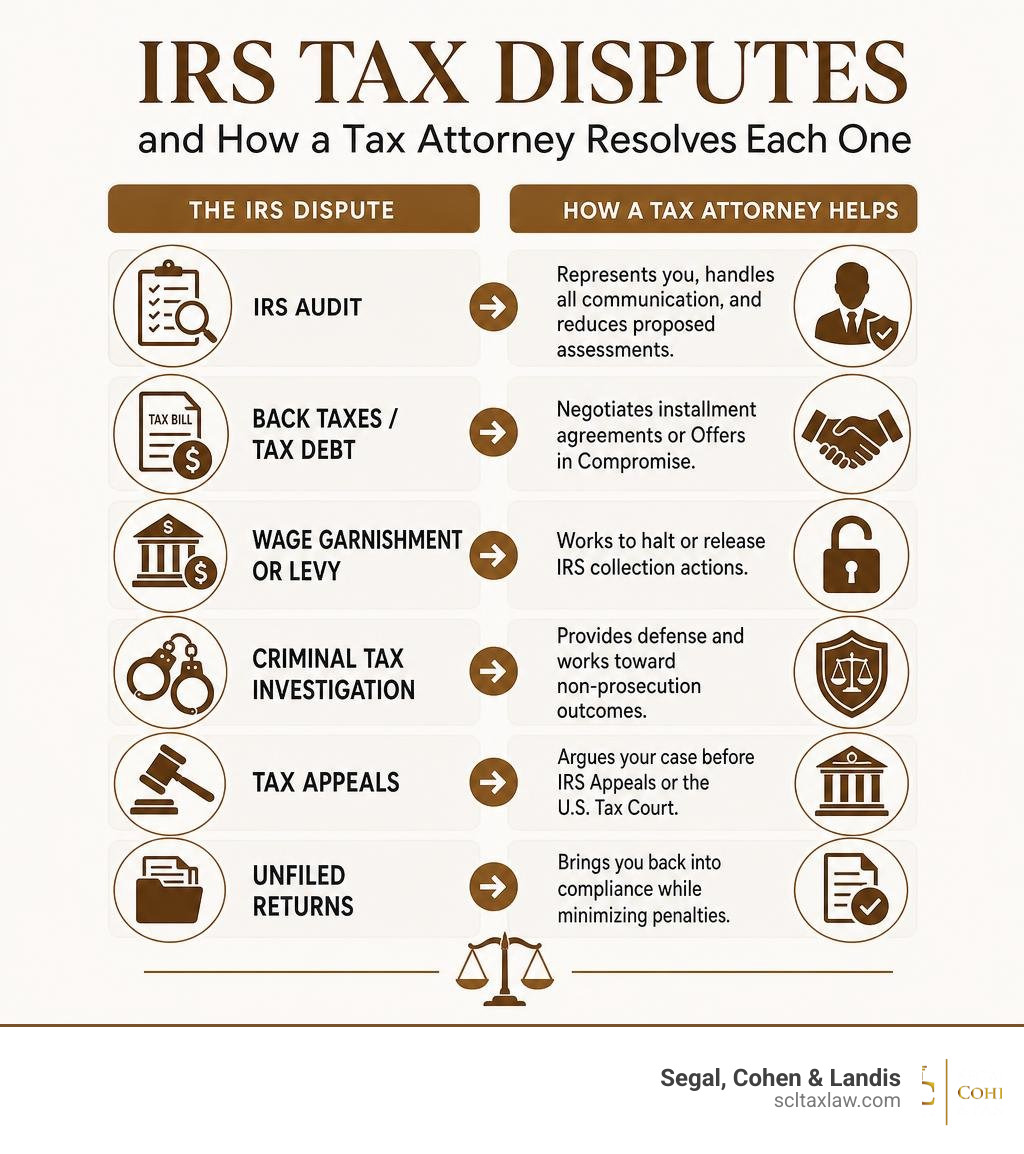
| Situation | How a Tax IRS Attorney Helps |
|---|---|
| IRS audit | Represents you, handles all communication, reduces proposed assessments |
| Back taxes / tax debt | Negotiates installment agreements or Offers in Compromise |
| Wage garnishment or levy | Works to halt or release IRS collection actions |
| Criminal tax investigation | Provides defense and works toward non-prosecution outcomes |
| Tax appeals | Argues your case before IRS Appeals or the U.S. Tax Court |
| Unfiled returns | Brings you back into compliance while minimizing penalties |
Facing the IRS alone is one of the most stressful financial experiences a person or business owner can go through. IRS notices arrive fast, deadlines are strict, and the consequences of a misstep — a lien on your home, a frozen bank account, a criminal referral — can be severe.
The good news: you don’t have to navigate this alone. Qualified tax attorneys exist specifically to stand between you and the IRS, protect your rights, and fight for the best possible outcome.
This guide discusses tax irs attorney experts reveal how to find qualified help. Review the applicable rules and facts, and verify the qualifications and scope of any proposed representation.
Simple tax irs attorney word guide:
Inside the IRS: Careers and Roles of Government Tax Professionals
To successfully resolve a dispute with the federal government, it helps to understand how the IRS is structured and who you are dealing with on the other side of the table. The IRS is not a single monolith; it is staffed by thousands of specialized professionals, including a massive legal department.
At the heart of the agency’s legal operations is the IRS Office of Chief Counsel, which employs approximately 1,500 attorneys. These government lawyers are responsible for interpreting tax laws, drafting regulations, advising the IRS Commissioner, and representing the agency in litigation.
If you are interested in how the government recruits these professionals, you can explore the official Legal & Tax Law – IRS Careers portal. Within the IRS, several key career paths exist for tax professionals:
- IRS Attorneys (Office of Chief Counsel): These lawyers work at both entry-level and highly experienced tiers. They are tasked with litigating thousands of cases annually in the U.S. Tax Court, defending the IRS’s tax assessments, enforcing summonses, and advising field agents on complex audits.
- Appeals Officers: These professionals conduct formal appeals conferences designed to settle complex tax disputes fairly and impartially. Their primary mandate is to resolve controversies without litigation, saving time and money for both the taxpayer and the government. They evaluate cases petitioned to the U.S. Tax Court and seek reasonable compromises based on the “hazard of litigation” (the likelihood of either side winning in court).
- Tax Law Specialists: These experts analyze systemic compliance issues under the Internal Revenue Code. They research complex transaction data, identify compliance trends, develop audit guidelines for field agents, and provide technical assistance to revenue agents during active examinations.
Review the relevant notices, filing history, records, and deadlines before choosing a response. Evaluate professional assistance according to the facts, applicable law, and agreed scope of representation.
Free and Low-Cost Resources for Taxpayers
Review the relevant notices, filing history, records, and deadlines before choosing a response. Evaluate professional assistance according to the facts, applicable law, and agreed scope of representation.
The Taxpayer Advocate Service (TAS)
The Taxpayer Advocate Service is an independent organization within the IRS. Think of them as your internal “tax ombudsman.” If you are experiencing significant financial hardship due to an IRS action, or if the IRS has failed to resolve your problem through normal channels, TAS can step in. They have the authority to issue Taxpayer Assistance Orders to halt collection actions and expedite delayed refunds.
Low Income Taxpayer Clinics (LITCs)
For low-income taxpayers or those who speak English as a second language (ESL), Low Income Taxpayer Clinics (LITCs) provide free or highly discounted legal representation.
LITCs are entirely independent of the federal government, even though they receive partial funding through IRS grants. They are typically operated by academic institutions (like law schools) or local non-profit legal aid organizations.
- Services Provided: LITCs can represent taxpayers in audits, administrative appeals, and collection disputes before the IRS. They can also assist with correcting account errors and responding to threatening IRS notices.
- How to Qualify: To qualify for LITC assistance, your household income must generally fall below a specific percentage of the federal poverty guidelines (typically 250% or less).
- How to Find One: The IRS publishes Publication 4134, which is a comprehensive directory of active LITCs across the country. You can also contact local state bar associations or non-profit legal aid societies for direct referrals.
When to Hire a Private Tax IRS Attorney
While government programs and clinics are excellent resources, they have strict income caps and limited operational scopes. If you do not qualify for free aid, or if your tax dispute involves substantial dollar amounts, complex business structures, or potential criminal exposure, hiring a private tax attorney is highly recommended.
If you are wondering where to start your search, you can consult an IRS Tax Attorney Guide to understand the representation landscape, or search for a qualified Tax Attorney Near Me to find a local advocate who understands your state’s tax environment.

Qualifications of an Experienced Tax IRS Attorney
Not all lawyers are equipped to handle IRS controversies. When searching for a private attorney, you should look for specific credentials that demonstrate deep technical expertise:
- Master of Laws (LL.M.) in Taxation: This is an advanced law degree obtained after graduating from law school, focusing exclusively on tax law.
- Dual Credentials (Attorney-CPA): An attorney who is also a Certified Public Accountant (CPA) possesses a powerful combination of legal defense skills and forensic accounting expertise.
- Board Certification: Some states, like California and Texas, offer specialized board certification in tax law to attorneys who pass rigorous exams and demonstrate experience in the field.
- Admission to the U.S. Tax Court: Your attorney must be admitted to practice before the U.S. Tax Court to file petitions and litigate on your behalf.
For a deeper dive into what makes a qualified representative, check out our comprehensive guide on IRS Tax Relief Attorneys.
How a Tax IRS Attorney Resolves Complex Disputes
A private tax attorney brings a robust legal toolkit to the table, allowing them to resolve a wide variety of IRS Tax Problems. These methods include:
- Audit Representation: We handle all correspondence, organize financial records, and present legal arguments to minimize proposed tax assessments.
- IRS Tax Debt Resolution: We negotiate collection alternatives such as an Offer in Compromise (OIC) or structured installment agreements to settle back taxes for less than what is owed. Learn more in our IRS Tax Debt Resolution.
- Criminal Tax Defense: If the IRS Criminal Investigation Division gets involved, an attorney is the only professional who can protect you with attorney-client privilege.
- Appeals and Litigation: We file appeals and represent clients in the U.S. Tax Court or federal district courts to challenge unfair IRS audits and determinations.
The Advantage of Former IRS Insider Experience
One of the most significant assets a private tax attorney can possess is prior experience working inside the government. Many top-tier tax attorneys began their careers as IRS Senior Trial Attorneys, Chief Counsel staff, or even IRS Revenue Officers.
This insider background provides several distinct advantages when representing taxpayers in private practice:
- Understanding the “Government Playbook”: Former IRS attorneys know exactly how the government builds its cases, what evidence they look for, and where their administrative weak points lie.
- Credibility and Relationships: Having worked alongside IRS personnel, former government attorneys speak the same technical language and maintain a high level of professional credibility, which can lead to smoother negotiations.
- Realistic Settlement Expectations: An insider knows when the IRS is likely to settle a case to avoid the hazard of litigation, allowing them to negotiate highly favorable compromise agreements.
Contact the firm to confirm meeting arrangements, the jurisdictions and matters it can handle, and the scope of any proposed engagement. Related resources: Annapolis Tax Lawyers; Albuquerque Tax Lawyers; Dallas Fort Worth.
Government Resources vs. Private Representation
Deciding whether to rely on free government resources or invest in a private tax attorney depends entirely on your financial situation and the complexity of your tax issue.
| Feature / Capability | Taxpayer Advocate Service (TAS) | Private Tax IRS Attorney |
|---|---|---|
| Cost | Free | Retainer fee / hourly or flat rate |
| Eligibility | Must meet financial or systemic hardship criteria | Anyone can hire |
| Scope of Service | Resolves administrative delays and procedural errors | Comprehensive defense: audits, appeals, litigation, criminal tax |
| Attorney-Client Privilege | None (communications are not legally privileged) | Privilege protects qualifying confidential legal communications, subject to exceptions and limitations; it does not shield all communications or underlying facts and records. |
| Litigation Capability | Cannot represent you in U.S. Tax Court | Full representation and advocacy in federal courts |
| Resolution Speed | Dependent on government backlogs and caseloads | Proactive, dedicated representation focused on your timeline |
Case Studies: Successful Outcomes in Complex Tax Disputes
The following scenarios illustrate issues to discuss with counsel. They are not verified firm case results or predictions of an outcome:
- Discuss the notice, disputed issues, available procedures and evidence with a qualified representative. Confirm the scope of engagement. Outcomes and timing depend on the facts and applicable requirements.
- Successful Offers in Compromise: Review the available options and applicable requirements for the particular matter. Outcomes depend on the facts and law; another taxpayer’s result does not predict yours. Confirm the scope of the proposed engagement.
- Penalty Abatement: By demonstrating that a taxpayer acted with reasonable cause and in good faith, tax attorneys routinely secure the removal of costly failure-to-file and failure-to-pay penalties. You can read more about how this works in our guide on IRS Tax Penalties.
- Eligible timely voluntary disclosure may be considered with other factors; it does not guarantee immunity. Check current eligibility, timeliness, cooperation and payment requirements. Related guidance: IRS Tax Fraud.
Frequently Asked Questions about Tax IRS Attorneys
What is the difference between a CPA and a tax attorney?
While both are highly qualified tax professionals, they serve different roles. CPAs are financial experts who excel at accounting, bookkeeping, and preparing complex tax returns.
Tax attorneys are legal experts who specialize in dispute resolution, tax litigation, and criminal defense. Crucially, tax attorneys provide attorney-client privilege, which prevents the government from forcing them to testify against you. Communications with a CPA do not enjoy this same absolute level of legal protection.
How do I qualify for a Low Income Taxpayer Clinic (LITC)?
To qualify for free or low-cost help from an LITC, your household income must generally be at or below 250% of the federal poverty guidelines. Additionally, the amount in dispute with the IRS must typically be under a certain threshold (historically $50,000 or less per tax year).
Can a tax attorney stop an IRS levy or wage garnishment?
Yes. A tax attorney can contact the IRS to request an immediate hold on collection actions. We can negotiate a levy release by setting up an installment agreement, proving financial hardship, or filing for Currently Not Collectible status.
For a step-by-step breakdown of this process, see our IRS Tax Levy Release Guide.
Conclusion
Facing the IRS can feel like an uphill battle, but you do not have to fight it alone. Whether you qualify for free assistance through a Low Income Taxpayer Clinic or require the robust advocacy of a private tax law firm, taking immediate action is the key to protecting your financial future.
Contact Segal, Cohen & Landis (SCL) to discuss the tax matter, relevant notices and deadlines, and available response options. Confirm the qualifications of the proposed representative and the scope of the engagement.
Ready to take the first step toward tax resolution? Schedule a consultation for professional tax services with our experienced team today.
Related guidance: Meet our attorneys.
Have questions about this topic? Talk to an IRS attorney today.
Segal, Cohen & Landis, P.C. — Beverly Hills. Serving clients nationwide.

Samuel Landis, Esq.
LL.M. (Tax) · Selected to Super Lawyers®
Sam Landis is a Beverly Hills IRS tax attorney specializing in IRS collection defense, audit representation, and international tax compliance for foreign nationals and US expats.