
What You Need to Know About California Tax Board Appeals
California tax board appeals provide a process to challenge qualifying state tax determinations. Identifying the response stage and applicable deadline helps you organize an informed response.
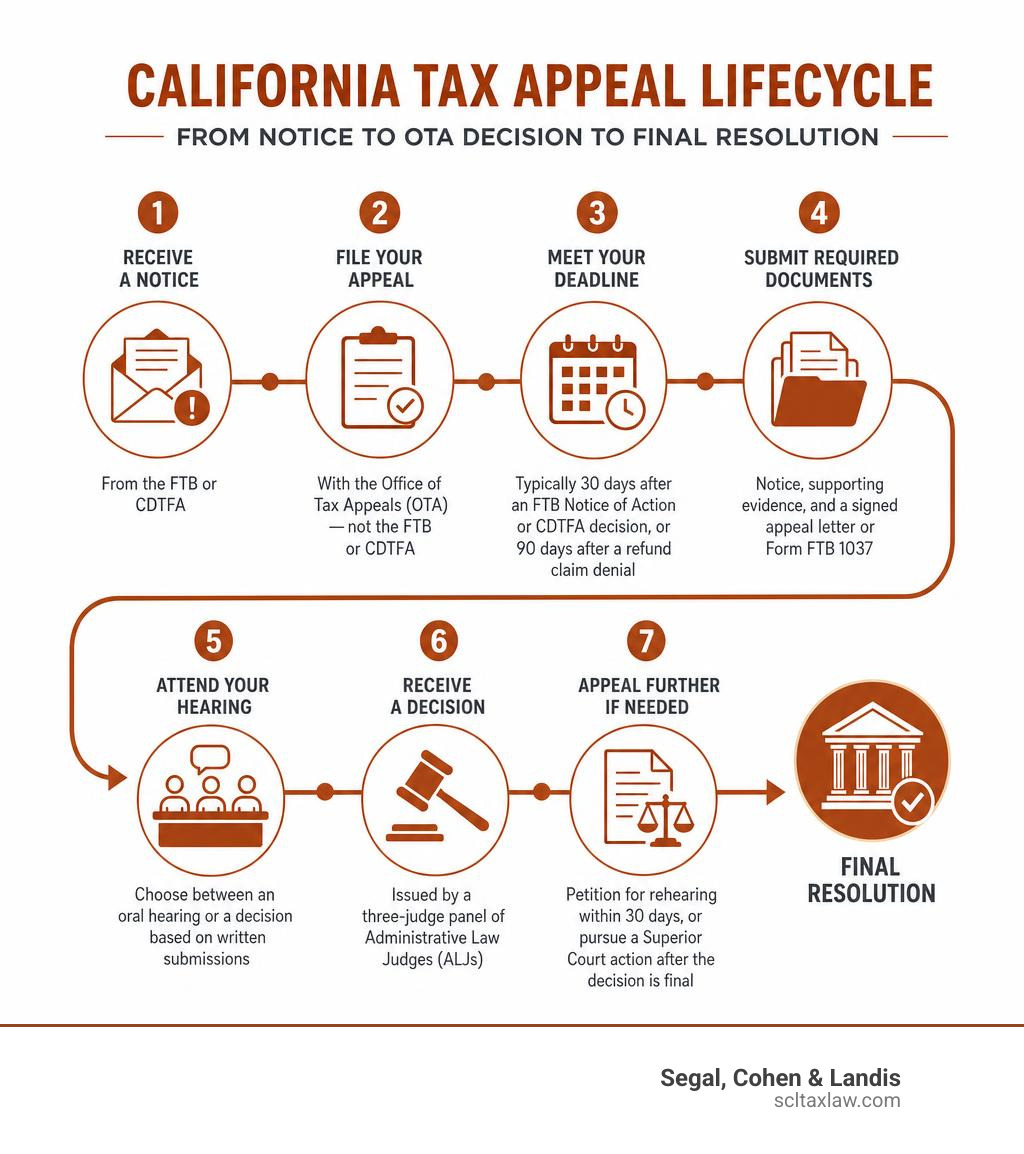
Here’s a quick overview of how to appeal a California tax decision:
- Receive a notice from the Franchise Tax Board (FTB) or California Department of Tax and Fee Administration (CDTFA)
- Identify the stage — an initial NPA protest goes to FTB; an appeal of a qualifying determination goes to OTA.
- Meet your deadline — identify the actual jurisdictional notice and confirm the filing deadline under the governing rule. Do not apply a single deadline to every FTB or CDTFA action.
- Submit required documents — a copy of your notice, supporting evidence, and a signed appeal letter or Form FTB 1037
- Attend your hearing — choose between an oral hearing or a decision based on written submissions
- Receive an opinion — generally from an ALJ panel; eligible Small Case Program appeals may use one ALJ.
- Appeal further if needed — petition for rehearing within 30 days, or pursue a Superior Court action after the decision is final
Facing a tax dispute with California is stressful. Deadlines are strict, the rules are complex, and a wrong move can cost you your right to appeal entirely.
The good news? You have real options — and a clear process to follow.
This guide distinguishes an initial agency protest from an OTA appeal and explains how to organize the notice, arguments and evidence for the applicable stage.
Understanding the California Tax Board Appeals Landscape
To successfully navigate California tax board appeals, we first need to clear up a common point of confusion: who actually handles what?
Historically, California’s tax appeal system was dominated by the Board of Equalization (BOE). However, a major legislative overhaul completely restructured how state tax disputes are resolved. Today, the process is split among three distinct entities: the Franchise Tax Board (FTB), the Board of Equalization (BOE), and the OTA | Office of Tax Appeals.
When you are hit with an unexpected tax assessment, understanding these administrative boundaries is critical. If you send your appeal to the wrong agency, you risk missing strict statutory deadlines, which can permanently forfeit your right to challenge the tax. For a deeper look into dealing with the primary income taxing authority, check out Your Go-To Guide for the California Franchise Tax Board.
To help keep these agencies straight, we have broken down their core functions below:
FTB vs. BOE vs. OTA: Quick Reference Table
| Agency | Primary Role | What They Handle | Do They Hear Appeals? |
|---|---|---|---|
| Franchise Tax Board (FTB) | Taxing & Auditing Authority | Personal income tax, corporate franchise tax | No. They issue assessments and review initial protests, but do not hear formal appeals. |
| Board of Equalization (BOE) | Constitutional Tax Board | Property taxes, alcoholic beverage taxes, insurer taxes | Only for specific property and constitutional taxes. They no longer handle income or sales tax appeals. |
| Office of Tax Appeals (OTA) | Independent Appeals Body | Appeals of FTB and CDTFA tax determinations | Yes. This is the independent agency that hears and decides your tax appeals. |
The Role of the Office of Tax Appeals (OTA)
Established on January 1, 2018, the Office of Tax Appeals (OTA) was created to provide a fair, impartial, and independent forum for taxpayers.
Before the OTA, tax appeals were heard directly by the elected members of the Board of Equalization. This setup faced heavy criticism because the agency acting as the tax collector was also acting as the judge. The OTA solved this conflict of interest.
OTA is independent of the taxing agencies. Most appeals use a panel of ALJs; qualifying appeals in the Small Case Program may be decided by one ALJ. The decision turns on the facts, evidence and applicable law.
The BOE retains limited tax functions, including state-assessed property matters. Most local property assessment disputes go to a county assessment appeals board or county board of supervisors, not local BOE staff. See BOE assessment-appeal guidance. FTB and CDTFA matters reach OTA only through the applicable appeal procedures.
How the OTA Differs from the FTB and BOE
FTB and CDTFA administer taxes and conduct agency-level reviews. OTA is an independent administrative appeals body, not a court. Separate each agency’s procedures from a later judicial refund action.
When the FTB audits your tax return and proposes changes, they are acting as the auditing agency. If you disagree with their audit findings, you must first file a formal “protest” directly with the FTB. This protest is an internal administrative review. If you want to learn more about how this initial stage works, see our guide on how to handle a California Franchise Tax Board Audit.
Only after the FTB reviews your protest and issues a formal “Notice of Action” (NOA) can you take your case to the OTA. The OTA does not collect taxes, conduct audits, or answer general tax questions. Its sole purpose is to act as an unbiased referee to decide if the FTB or CDTFA made the correct decision under California law.
Eligibility and Types of Decisions You Can Appeal
You cannot appeal to the OTA just because you are unhappy with a tax bill. There must be a formal, appealable event.
According to the official guidelines on how to Appeal a decision | FTB.ca.gov, you generally have the right to file an appeal with the OTA under the following circumstances:
- Notice of Action (NOA): The FTB has denied your internal audit protest and issued a formal NOA.
- Claim for Refund Denial: You paid a tax, filed a formal claim for a refund with the FTB or CDTFA, and they denied that claim.
- Deemed Denial of Refund: You filed a claim for a refund, and the taxing agency has failed to act on it (neither accepting nor denying it) within six months.
- Residency Determinations: The FTB has audited you and determined you are a California resident, subjecting your global income to state tax. This is a highly litigated area. For more information on how California defines residency, see Residency and Taxing in California.
Eligible Tax Types for California Tax Board Appeals
The OTA has jurisdiction over a wide variety of state tax and fee disputes. The most common tax types appealed include:
- Personal Income Tax: Disputes regarding deductions, business income, filing status, or residency.
- Corporate Franchise Tax: Corporate tax liabilities, minimum franchise fees, and apportionment.
- Sales and Use Tax: Audits and determinations issued by the CDTFA.
- Special Taxes and Fees: Cannabis taxes, fuel taxes, tobacco taxes, and environmental fees administered by the CDTFA.
If you are dealing with penalties or interest associated with these taxes, you may also appeal the denial of a penalty waiver or abatement. To understand how to request relief before reaching the appeal stage, read our resource on How to Get Franchise Tax Board Abatement in 5 Steps.
Key Requirements for Filing California Tax Board Appeals
Filing a successful appeal requires meeting strict procedural hurdles. The OTA will reject appeals that do not comply with basic filing standards.

Every written appeal submitted to the OTA must include:
- Taxpayer Information: Your name, address, phone number, and Social Security Number (SSN) or Taxpayer Identification Number (TIN).
- The Disputed Notice: A clear copy of the Notice of Action, denial letter, or decision you are appealing.
- The Disputed Amount: The specific tax years and the exact amount of tax, penalties, or interest you are contesting.
- Statement of Facts and Laws: A clear, detailed explanation of why you believe the taxing agency’s decision is wrong, backed by supporting facts and legal authorities.
- Signature: The appeal must be signed by you (and your spouse if you filed a joint return) or your authorized representative.
Step-by-Step Guide to Filing Your Appeal
Once you have determined that you are eligible and have gathered your documentation, it is time to file. The formal rules governing this process are outlined in the official APPEALS PROCEDURES manual.
Submit the appeal directly to OTA using its filing instructions. Review the appeal record and confirm which documents the taxing agency has provided and which supporting materials you must submit. Do not assume that every prior document is already in the record or that every item must be resubmitted.
If you need to contact the taxing agency directly to request copies of your audit file or clarify their findings before drafting your appeal, you can refer to our Detailed Guide to CA State Franchise Board Contact.
Timelines and Deadlines to Remember
California tax appeal deadlines depend on the notice and proceeding. Read the appeal-rights instructions, calendar the mailing and filing dates, and obtain prompt advice if timeliness is uncertain. Do not assume that further contact with an agency preserves an appeal.
As of May 2026, the standard filing deadlines are:
- FTB Notice of Action on a Protest: You must file your appeal within 30 days of the date printed on the Notice of Action.
- FTB Claim for Refund Denial: You must file your appeal within 90 days of the date the denial notice was mailed.
- CDTFA Decision: Review the actual decision, its appeal instructions and the governing rule promptly. Confirm that OTA has jurisdiction and calculate the applicable deadline for that decision.
To illustrate how unyielding these deadlines are, we can look at the precedential case 2023 – OTA – 366 (Appeal of P. Rive and N. Dvorak). In this case, the taxpayers faced a substantial estimated tax penalty. They argued that they underpaid their estimated taxes because they were missing crucial cost-basis information from their financial broker.
The OTA ruled that estimated tax penalties are mandatory additions to tax under California law, and there is no general “reasonable cause” exception to waive them. This case highlights a critical truth about California tax appeals: equity and good intentions do not override statutory rules and deadlines.
Submission Methods: Online, Mail, and Fax
The OTA offers three primary methods for submitting your appeal:

- Online via OTAP (Preferred): The Office of Tax Appeals Portal (OTAP) is the fastest and most secure way to file. You can create an account, upload your documents, and track your case’s progress in real-time.
- By Mail: You can mail your written appeal package to:
> Office of Tax Appeals
> P.O. Box 989880
> West Sacramento, CA 95798-9880 - By Fax: You can fax your appeal to (916) 492-2089.
Tip: If you are filing by mail, we strongly recommend using certified mail with return receipt requested so you have proof of the date you mailed your package.
What to Expect During the OTA Hearing Process
Once your appeal is filed, the “briefing process” begins. This is a structured exchange of written arguments between you (the appellant) and the taxing agency (the respondent).
OTA sends procedural correspondence and establishes a briefing schedule. The order and time allowed can depend on the appeal type and extensions granted. Follow the actual acknowledgment and briefing notices rather than a generic timetable.
During this phase, we highly recommend utilizing professional representation to ensure your briefs are structured logically, cite the correct legal precedents, and comply with the OTA’s strict page and formatting limits. For more information on how professional advocates handle these disputes, explore our California State Tax Resolution Services.
Oral Hearings vs. Written Record Decisions
You may choose an oral hearing or a decision on the written record. Standard appeals use three panel members; Small Case Program appeals use one.
- Decision on the Written Record: OTA decides the appeal using the submitted evidence and briefs, without an oral hearing, and issues a written opinion. OTA guidance says an opinion is typically received within six months after briefing is completed; timing can vary.
- Oral Hearing: If you request an oral hearing, you will have the opportunity to present your case, call witnesses, and answer questions directly from the judges.
OTA hearings and submitted appeal materials are generally public. Before filing sensitive information, review OTA’s rules on personal-information redaction, requests to seal records and requests for a closed hearing. These protections have conditions; confidentiality is not automatic.
Hearing Locations and Virtual Options
To make the process accessible, the OTA conducts hearings in several formats and locations:
- In-Person Hearings: The OTA regularly schedules in-person hearings in Sacramento, Los Angeles, and Fresno.
- Virtual Hearings: Taxpayers can choose to participate in their hearing virtually via Zoom. This has become an incredibly popular option, saving taxpayers time and travel costs.
If you are a resident of Southern California and are preparing for a local or virtual hearing, our Los Angeles California Tax Attorneys Guide provides regional insights on navigating state tax controversies.
Before an OTA Appeal: Build an FTB NPA Protest File
A Notice of Proposed Assessment starts a different response stage from an FTB Notice of Action. An NPA protest goes to FTB; a later appealable determination may lead to OTA. Use the notice’s Protest By date and instructions rather than sending an initial NPA protest directly to OTA.
Build an adjustment-by-adjustment worksheet before assembling exhibits. A general statement that the assessment is wrong gives the reviewer little to evaluate. Separate a factual disagreement, a calculation error and a disagreement about the governing law.
| Worksheet field | What to record |
|---|---|
| Adjustment | NPA item, tax year, amount and FTB explanation |
| Your position | The disputed fact, calculation or legal treatment |
| Supporting exhibit | Document name, date, relevant page and what it establishes |
| Authority | The rule you contend applies and its connection to the facts |
| Missing information | The outstanding record, source and person obtaining it |
For a residency adjustment, separate residence evidence from income-source evidence. For an omitted payment, reconcile the payment confirmation to the specific tax period. For a disputed income item, identify the underlying statement and calculation instead of attaching an unexplained stack of records.
Include the taxpayer identification and notice details required by FTB, the requested changes, reasons for disagreement, supporting documents and the required signature or representative authorization. Use an exhibit index and preserve the exact submission with transmission or delivery evidence. Check the current agency instructions for the permitted submission method.
If FTB later issues a Notice of Action, create a new deadline entry and compare the determination with your protest worksheet. An earlier submission does not itself satisfy a later OTA appeal requirement. Payment, deposit and interest questions should be evaluated separately from the merits of the protest.
Consult FTB’s NPA protest instructions and FTB protest-process guidance. For the examination stage, see our FTB audit guide. Guidance checked October 1, 2026.
Frequently Asked Questions about California Tax Board Appeals
Can I represent myself at an OTA hearing?
Yes, you have the legal right to represent yourself (known as appearing pro se). The OTA is designed to be accessible to everyday taxpayers, and you do not need to be an attorney or CPA to file an appeal.
However, state tax laws are notoriously dense. The FTB and CDTFA will be represented by highly experienced, specialized state tax attorneys who know every loophole and procedural rule. Going up against them alone can feel like playing a professional sports team without a coach.
If your appeal involves a significant amount of money, complex residency audits, or business tax issues, securing professional representation is highly recommended. To learn more about how we can help level the playing field, visit our Tax Resolution Services California page.
What happens if I lose my appeal at the OTA?
If the three-judge panel rules against you, you have two primary options:
- Petition for Rehearing (PFR): OTA’s published guidance provides 30 days from the date it issued the Opinion to submit a petition for rehearing. Review the issued Opinion and applicable OTA rules for the filing requirements and permitted grounds; disagreement alone does not establish a ground.
- California Superior Court: Judicial review generally uses the applicable paid-tax refund procedure. Payment, a refund claim and the triggering agency or OTA action must be evaluated together. Deadlines differ by proceeding, including special rules for residency disputes; do not assume every court action has the same 90-day period. See FTB Publication 985.
How long does the entire appeal process take?
The timeline varies depending on the complexity of the case and whether you request an oral hearing.
The duration depends on the case, briefing, evidence and hearing schedule. A written-record case can still require substantial time. Ask OTA about the actual schedule and do not treat an estimated number of months as a guaranteed completion date.
Conclusion
Navigating California tax board appeals can feel like walking through a legal minefield. From strict 30-day deadlines to complex evidentiary requirements and formal briefing schedules, a single mistake can result in your case being thrown out before a judge even looks at the facts.
But you do not have to fight the state of California alone.
Our California tax resources cover residency audits, agency protests and OTA appeals. The appropriate response depends on the notice, procedural stage and supporting record; representation does not guarantee a particular outcome.
Review the relevant notices, filing history, records, and deadlines before choosing a response. Evaluate professional assistance according to the facts, applicable law, and agreed scope of representation. Related resources: Category: California Taxes.
Have questions about this topic? Talk to an IRS attorney today.
Segal, Cohen & Landis, P.C. — Beverly Hills. Serving clients nationwide.

Samuel Landis, Esq.
LL.M. (Tax) · Selected to Super Lawyers®
Sam Landis is a Beverly Hills IRS tax attorney specializing in IRS collection defense, audit representation, and international tax compliance for foreign nationals and US expats.