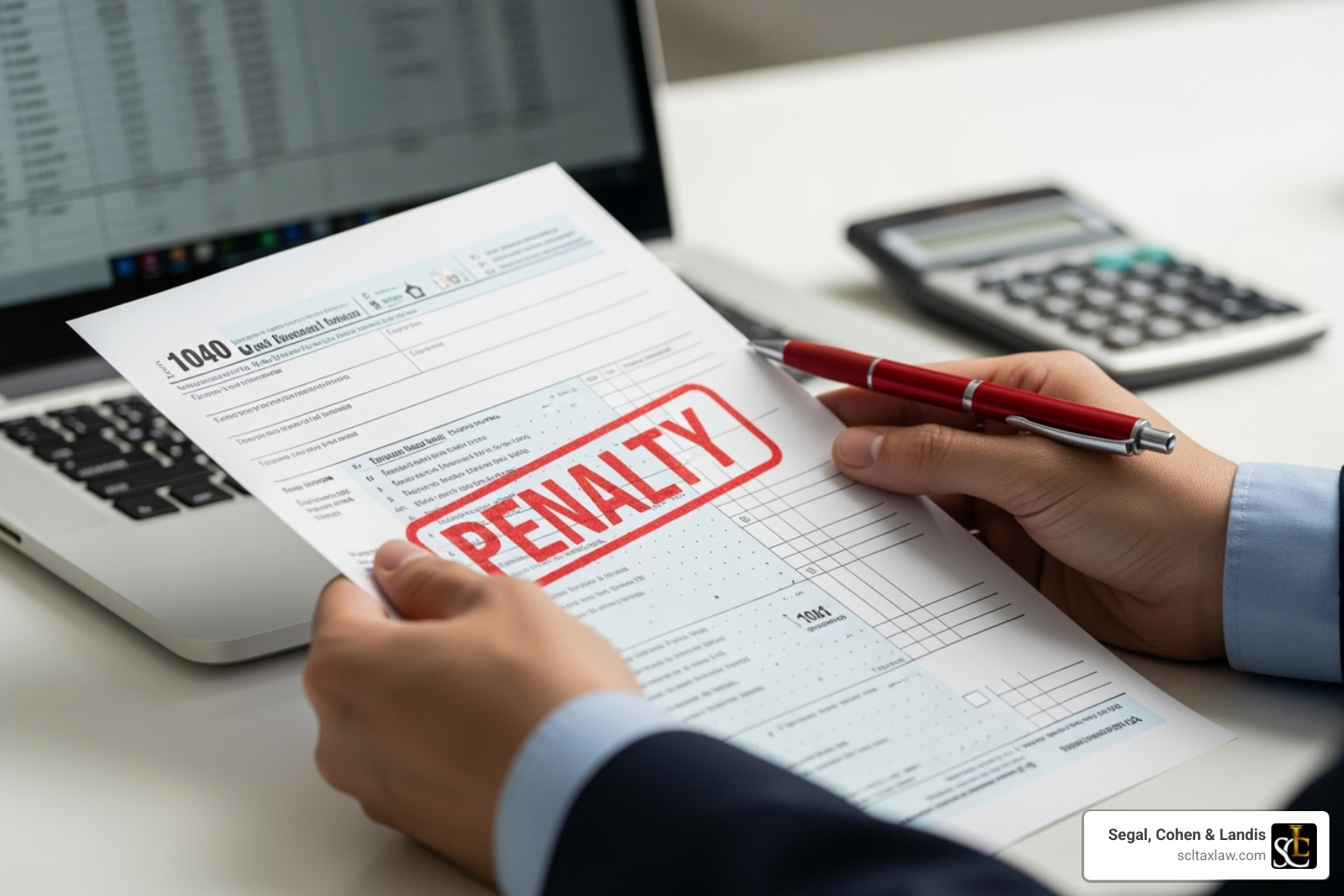



IRS ペナルティを先手を打って回避すれば、数千ドルの節約につながる理由
You can avoid IRS のペナルティ by taking simple, proactive steps. The IRS charges penalties for 遅延申告, 遅延納付, underpayment, inaccurate returns, and bounced checks. Here’s how to steer clear:
IRS ペナルティを回避するための簡単な方法:
- 期限内に申告する (全額納付できない場合でも)
- 期限までに納付すべき税額を支払う (または分割払い計画を設定する)
- 予定納税を行う 自営業者の方や源泉徴収されない収入がある場合
- 源泉徴収額が正確であることを確認する IRS の税源泉徴収試算ツールを使用して
- 適切な記録を保持する 申告書の正確性を再確認する
- 期限延長を申請する 申告に追加時間が必要な場合(ただし、当初の期限までに納付する)
While there’s no penalty for filing late if you owe nothing, the consequences are steep if you do owe. The Failure to File penalty is 5% of unpaid tax per month (up to 25%), while the Failure to Pay penalty is 0.5% per month (up to 25%). Owing over $1,000 after withholding can also trigger an underpayment penalty.
The good news is that many penalties can be reduced or removed for 正当な理由 (like a disaster or illness) or through First-Time Penalty Abatement for those with a clean compliance history. Acting quickly saves money and stress.
I’m Attorney Samuel Landis, Managing Partner at Segal, Cohen & Landis. For over 15 years, I’ve helped clients resolve complex 税務紛争. My focus is on helping 納税者 avoid IRS のペナルティ through proactive planning and securing relief when penalties arise.

最もよくある IRS ペナルティを理解する
Finding an IRS のペナルティ notice in your mailbox is stressful. But these penalties aren’t random; they are IRS’s way of encouraging compliance with 税法 and follow specific rules. Understanding how these penalties work is the first step to avoiding them.

The IRS assesses penalties for various reasons, including 遅延申告, 遅延納付, and inaccurate returns. Each error triggers a specific penalty with different rates.
Here are the five most common penalties:
申告書未提出: Occurs when you miss the tax 申告期限. It’s a frequent and costly penalty.
未納: Applies when you don’t pay your taxes by the due date, even if you filed on time.
予定納税額の過少申告: Affects those who don’t pay enough tax throughout the year via withholding or estimated payments. This is common for the 自営業者, freelancers, and those with investment income.
正確性関連ペナルティ: Charged for mistakes that understate your 税務上の債務, such as carelessness or a substantial understatement of income.
Dishonored Check Penalty: Assessed if you pay your taxes with a check that bounces.
Failure to File vs. Failure to Pay
These two penalties are often confused, but understanding their differences is key to saving money.
The Failure to File penalty is the more aggressive of the two. The IRS charges 5% of the unpaid tax for each month (or part of a month) that a return is late, up to a maximum of 25%. For returns due in 2024, there’s a minimum penalty of $485 if you’re more than 60 days late.
The Failure to Pay penalty is less severe but still adds up. It’s 0.5% of the unpaid tax for each month the tax remains unpaid, also capping at 25%.
If you fail to file and pay in the same month, IRS doesn’t charge a full 5.5%. Instead, the Failure to File penalty is reduced by the Failure to Pay penalty, resulting in a combined 5% per month.
Here’s how these two stack up side by side:
| Penalty Type | Rate | Maximum Cap | When Both Apply |
|---|---|---|---|
| Failure to File | 5% of unpaid tax per month | 25% | Reduced by Failure to Pay penalty, max 5% combined per month |
| Failure to Pay | 0.5% of unpaid tax per month | 25% | Applies in addition to Failure to File, but capped |
The lesson is clear: even if you can’t pay, always file on time. Filing protects you from the much steeper Failure to File penalty.
Underpayment and Accuracy-Related Penalties
The Underpayment of Estimated Tax Penalty often surprises people. The U.S. has a “pay-as-you-go” system, meaning IRS expects you to pay taxes throughout the year. If you owe $1,000 or more when you file, you could face this penalty. This often affects 自営業者 individuals, gig workers, and those with income not subject to withholding.
Accuracy-Related Penalties come into play when there are problems with your return’s accuracy. These penalties are typically 20% of the underpayment due to the error, but can jump to 40% in serious cases.
Triggers include substantial understatement of tax, negligence or disregard of rules, and gross valuation misstatements (significantly overstating property value to lower your tax bill).
To avoid these penalties, be thorough, keep good records, and ask for professional help when unsure. It’s cheaper than paying penalties later.
Proactive Strategies To avoid IRS Penalties
Most IRS のペナルティ are preventable. The key is to understand IRS expectations and act before problems arise. A little effort now can save you thousands. Avoiding penalties relies on three habits: filing on time, paying on time, and keeping good records.
Master Your Filing and Payment Deadlines
Meeting deadlines is the simplest way to avoid IRS のペナルティ. The annual deadline to file federal income 税務申告書 and pay taxes owed is April 15th (or the next business day).
If you’re not ready by Tax Day, file Form 4868 for an automatic extension to October 15th. This saves you from the steep Failure to File penalty.
Crucially, an extension to file is not an extension to pay. Your tax payment is still due by the original April deadline. The IRS gives you more time for paperwork, not for payment.
If you can’t pay your full tax bill by April 15th, file anyway and pay as much as you can. By filing on time, you avoid the 5% per month Failure to File penalty and will only face the much smaller 0.5% per month Failure to Pay penalty.
If you need more time to pay, an IRS 分割払い合意 allows monthly payments for up to 72 months. While ペナルティと利息 still apply, a 支払い計画 reduces future penalties and is better than ignoring the debt.
Conquer the ‘Pay-As-You-Go’ System to Avoid IRS Penalties for Underpayment
The U.S. tax system is “pay-as-you-go,” meaning you must pay tax as you earn income. Mastering this system is crucial to avoid IRS のペナルティ for underpayment.

For employees, this happens via withholding based on your Form W-4. You should adjust your W-4 after major life events like marriage, a new baby, or starting a side business. Use IRS’s Tax Withholding Estimator tool to ensure you’re withholding the correct amount.
For income not subject to withholding (自営業, freelance work, rental income, etc.), you must make estimated tax payments. Use Form 1040-ES to calculate what to pay each quarter.
The four quarterly due dates are April 15th, June 15th, September 15th, and January 15th of the following year. Set calendar reminders to avoid missing these dates.
The Safe Harbor Rules for Estimated Taxes
Estimating annual income can be difficult. Fortunately, IRS provides “safe harbor” rules to help you avoid IRS のペナルティ for underpayment, even with imperfect estimates.
You generally won’t face a penalty if you meet one of these conditions:
- Pay 90% of your current year’s tax through withholding and estimated payments.
- Pay 100% of the tax shown on your prior year’s return (if it covered 12 months). This is often easier as the number is already known.
There’s an exception: if your prior year’s adjusted gross income (AGI) was over $150,000 ($75,000 if married filing separately), the safe harbor increases to 110% of your prior year’s tax.
If you owe less than $1,000 after withholding and credits, you typically won’t face a penalty.
For those with fluctuating income (e.g., seasonal businesses, commissions), the Annualized Income Method allows you to base payments on when income is earned. While more complex, it can save you money if your income is uneven. See Form 2210 and its instructions for details.
To avoid other penalties, ensure you have sufficient funds before paying IRS, double-check all figures for accuracy, and timely file information returns like W-2s and 1099s.
What To Do If You Receive A Penalty Notice
Receiving a penalty notice from IRS is stressful, but don’t panic. Dealing with it promptly and calmly is the best path forward.
First, verify the information in the notice and understand the reason for the penalty. Read IRS letter carefully. Mistakes can happen, so if something looks incorrect, follow the notice’s instructions to resolve it.
Acting promptly is crucial. Ignoring a notice won’t make it disappear; it will grow as IRS charges interest on penalties until they’re paid in full. The sooner you address it, the less you’ll pay. If a penalty is reduced or removed, the related interest is automatically adjusted.
Requesting Penalty Relief: Abatement Options
You may qualify for ペナルティ救済 if you tried to comply with 税法 but couldn’t due to circumstances beyond your control.

First-Time Penalty Abatement (FTA) is an excellent option if you have a good compliance history. To qualify, you must have filed all returns, paid (or arranged to pay) your tax, and have no penalties for the prior three 課税年度s. FTA applies to Failure to File, Failure to Pay, and Failure to Deposit penalties. It’s a way to avoid IRS のペナルティ from a single mistake.
If you don’t qualify for FTA, Reasonable Cause may provide relief. This applies if you exercised ordinary business care but were still unable to meet your obligations. Valid reasons include:
- Natural disaster (fire, flood, etc.)
- Serious illness or incapacitation (yours or an immediate family member’s)
- Death of an immediate family member
- Unavoidable absence or inability to obtain necessary records
A successful 正当な理由 claim requires 書類. Gather evidence like medical records, death certificates, or insurance claims to support your case and show why you couldn’t comply.
The Process for Appealing a Penalty
If you believe you have grounds for relief, you have clear options.
Calling IRS at the number on your notice is often the quickest route for Failure to File, Failure to Pay, and Failure to Deposit penalties.
For other penalties or if a call is unsuccessful, submit a written request using Form 843, Claim for Refund and Request for Abatement. Clearly explain your reasons and attach supporting documents.
If your request is denied, you can appeal the decision. The denial notice will explain how to write a formal letter to IRS Office of Appeals.
If you’re struggling, help is available. The Taxpayer Advocate Service is an independent organization within IRS that assists 納税者. For complex cases, professional 税法 assistance is essential. At Segal, Cohen & Landis, we have over 33 年の経験 helping clients avoid IRS のペナルティ and resolve them when they occur.
Frequently Asked Questions About Avoiding IRS Penalties
Here are answers to the most common questions we hear from clients about IRS のペナルティ.
What’s more severe, the Failure to File or Failure to Pay penalty?
The Failure to File penalty is much more severe. It’s 5% of your unpaid tax per month, compared to the Failure to Pay penalty’s 0.5% rate. While both cap at 25%, the Failure to File penalty accumulates ten times faster. If both apply, the combined rate is capped at 5% per month. This is why it’s critical to file on time, even if you can’t pay the full amount.
Can I get a penalty waived if it’s my first mistake?
Yes, IRS offers First-Time Penalty Abatement (FTA) for 納税者 with a clean compliance history. If you’ve filed all required returns, paid or arranged to pay your tax, and had no penalties for the three prior years, you may qualify for a waiver on Failure to File, Failure to Pay, or Failure to Deposit penalties. It’s a valuable option for an isolated mistake and a straightforward way to avoid IRS のペナルティ after they’ve been assessed.
If I can’t pay my taxes, should I still file my return?
Yes, absolutely. Always file your return on time, even if you can’t pay. The Failure to File penalty is ten times higher than the Failure to Pay penalty, so not filing is a costly mistake. File by the deadline, pay what you can, and immediately contact IRS to set up a 支払い計画. This proactive approach minimizes penalties and shows IRS you’re making a good-faith effort to comply, which can open up options for relief.
結論
Taking control of your tax situation is manageable. The IRS’s goal is compliance, not punishment. By understanding how penalties work and taking proactive steps—like filing on time and keeping up with estimated payments—you can avoid IRS のペナルティ, saving money and stress. If you do receive a penalty notice, options like First-Time Penalty Abatement and 正当な理由 relief are available.
The most important step is to act quickly on any IRS の通知. Ignoring it allows interest to accumulate, making the problem worse. A prompt response, proper 書類, and understanding your rights can lead to a much better outcome.
At Segal, Cohen & Landis, we’ve spent over 33 years helping more than 25,000 clients in Los Angeles and beyond steer these situations. From simple mistakes to complex disputes, we guide clients with clarity and compassion. You don’t have to face 税務上の問題 alone.
Whether you’re facing a deadline, penalties, or 滞納税, 私どものチーム is here to help. We specialize in resolving federal and state 税務上の問題 with effective, customized solutions.
If you’re ready to take control of your tax situation, reach out to us today. We can help you understand your rights, negotiate with IRS, and explore solutions like an Offer in Compromise to settle your 税務上の債務 for less than you owe.
You’ve taken the first step by learning how to avoid IRS のペナルティ. Now let us help you take the next step toward lasting 安心.